When Content Experts, AI Architects, and DXP Engineers Walked Into the Same Room: We Unlocked a Superpower
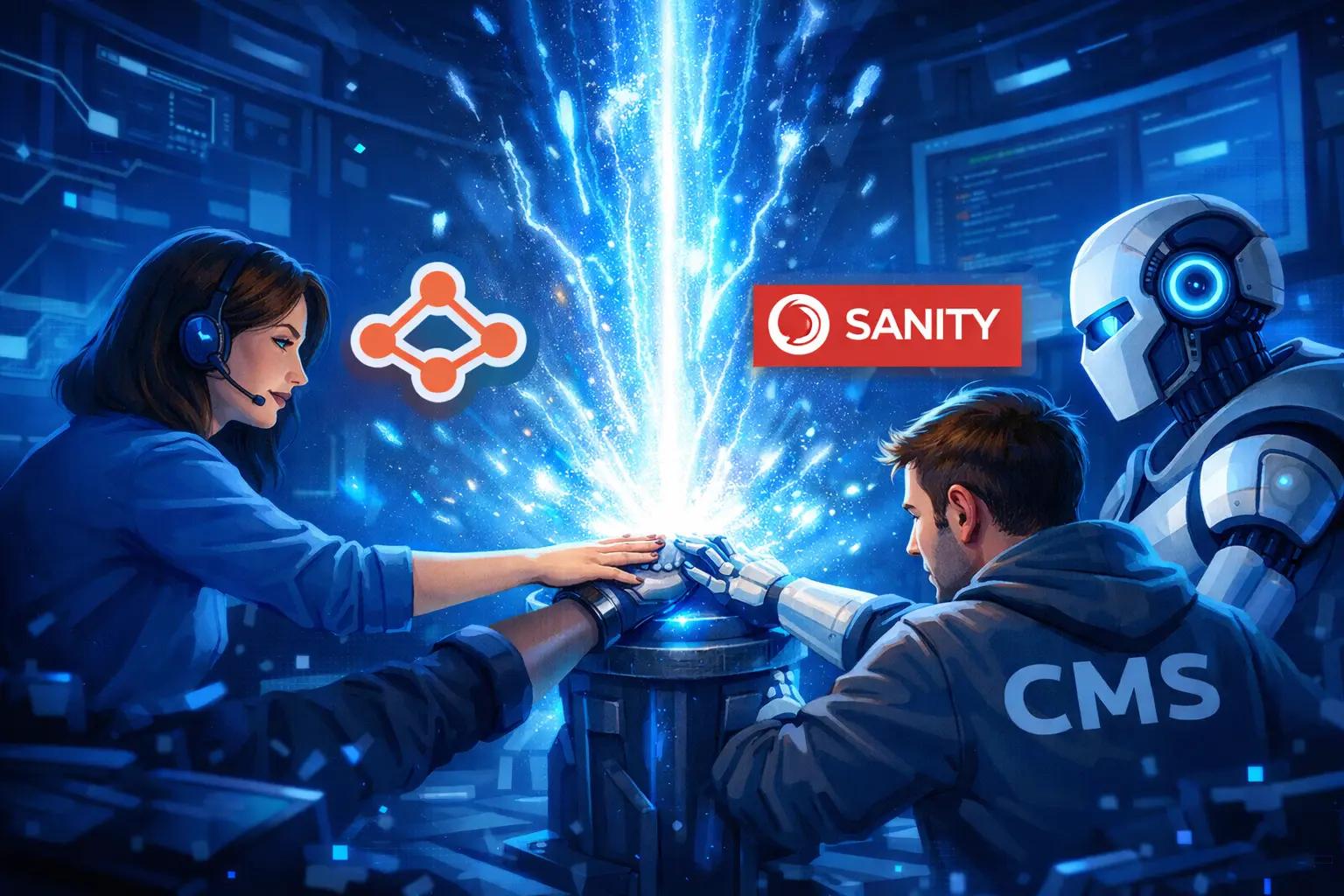
Something remarkable happened when we stopped thinking about AI as a tool and started thinking about it as a team member. At HT Blue, we brought together our content strategists, our AI systems engineers, and our DXP platform architects for what we thought would be a routine brainstorming session. What emerged from that room changed how we approach content operations entirely.
We discovered something that sounds almost too simple to be revolutionary: the real power of AI in content management isn't in any single capability. It's in orchestration. In connecting intelligent systems to each other, to your content, to your data, and most importantly, to the humans who understand what good content actually looks like.
The Convergence That Changed Everything
For years, we had been building expertise in parallel silos. Our content team knew how to craft compelling healthcare messaging that met strict compliance requirements. Our platform engineers understood the deep architecture of systems like Sanity, Sitecore, and Optimizely. Our automation specialists were building increasingly sophisticated workflows with tools like n8n. But these capabilities rarely intersected in meaningful ways.
The breakthrough came when we realized that AI orchestration isn't about replacing any of these specialties. It's about creating a connective tissue between them.
Picture this: A healthcare organization with thousands of web pages, many of them aging, some no longer compliant with current regulations, others referencing outdated treatment protocols or physicians who no longer practice there. Traditionally, auditing this content required armies of reviewers spending months combing through every page. Even then, they'd miss things. Content decay is insidious because it happens gradually, invisibly, until suddenly your website is filled with information that could expose patients to risk or your organization to liability.
We built something different. An intelligent system that monitors content continuously, understands context, and knows when something needs human attention.
The Architecture of Intelligent Content Operations
The foundation of what we've built rests on a principle that the industry is finally starting to embrace: agentic content management. Forrester's Q1 2025 CMS evaluation highlighted this shift, noting that leading platforms are now generating AI-powered content variants at scale while using AI agents to enhance how content teams interact with digital content. But our approach goes further because we control the orchestration layer.
Our system architecture follows what I think of as the "informed decision" pattern. At its core sits n8n, the open-source workflow automation platform that raised $60 million earlier this year precisely because the market recognized that AI and automation are natural complements. n8n gives us something critical: the ability to coordinate multiple AI models, multiple data sources, and multiple CMS platforms through a single orchestration layer.
Here's what that looks like in practice. We can connect Claude for nuanced content analysis and writing recommendations. We can bring in Gemini for rapid pattern recognition across large content sets. We can leverage ChatGPT for specific tasks where its training excels. The Model Context Protocol, which Anthropic open-sourced in late 2024 and has since been adopted by OpenAI, Google, and others, means we don't have to build custom integrations for each model. MCP has become what one industry analyst called "USB-C for AI applications" because it provides a universal standard for connecting AI systems with data sources.
But models alone accomplish nothing without context. That's where our DXP expertise becomes essential. Whether a client runs Sanity, Sitecore, Optimizely, Adobe Experience Manager, or any other enterprise platform, we connect our orchestration layer directly to their content repository. The AI doesn't just read content, it understands the content model, the relationships between pieces, the metadata that matters for compliance and findability.
The Healthcare Case Study: Continuous Content Compliance
Let me describe a real deployment that illustrates why this approach matters. A large regional healthcare network came to us with a problem that kept their compliance officers awake at night. Their public website had grown organically over fifteen years. Thousands of pages across multiple service lines, physician directories, treatment descriptions, facility information, and educational content. They knew some of it was outdated. They suspected some of it might actually violate current compliance requirements. But the scope of auditing everything manually was simply untenable.
We deployed an n8n workflow that runs continuously, systematically crawling their content and applying multiple layers of intelligent analysis. The system evaluates content freshness, flagging anything that hasn't been updated in over twelve months for review. It applies natural language processing to identify potentially problematic language, outdated medical terminology, or references to guidelines that have been superseded.
Most importantly, it connects to their internal systems. When a physician leaves the practice, the system identifies all content referencing that provider and generates a prioritized list for the content team to update. When a treatment protocol changes, pages discussing that treatment get flagged automatically. When regulatory guidance shifts, the system can assess which content might be affected.
Research published in 2025 indicates that AI-powered healthcare compliance implementations have achieved up to 87 percent fewer regulatory violations compared to manual approaches. We've seen similar results because continuous monitoring catches problems before they become violations, and intelligent prioritization means human reviewers spend their time where it matters most.
The Plug-and-Play Revolution
What makes our approach particularly powerful is its modularity. We've essentially created a content intelligence layer that sits above any CMS platform. This isn't theoretical architecture. We've deployed variations of this system on Sanity, Sitecore, Optimizely, Adobe Experience Manager, Drupal, and custom platforms.
The pattern works like this: Our orchestration layer connects to the CMS through its native APIs or direct database access where appropriate. We pull content into a structured format that our AI agents can analyze. Those agents apply their specific expertise, whether that's compliance checking, SEO optimization, content quality scoring, or competitive analysis. The results flow back into workflows that either update content directly in the CMS or queue items for human review depending on the confidence level and the stakes involved.
This is where having prompt engineers who are also content strategists becomes invaluable. The AI does what AI does well: processing massive amounts of information, identifying patterns, applying consistent rules at scale. But the humans, our humans, understand the nuances of brand voice, the regulatory landscape of specific industries, the difference between technically accurate content and content that actually helps someone make a healthcare decision.
The industry calls this "human-in-the-loop" design, but I think that undersells it. It's more like human-at-the-helm. The AI provides propulsion and navigation assistance, but experienced professionals set the destination and make the judgment calls.
Connecting First-Party and Third-Party Data
One of the most powerful capabilities we've unlocked is the ability to connect AI agents to virtually any data source. Your CMS content is just the starting point. We can connect to your marketing automation platform to understand how content performs across campaigns. We can pull in analytics data to identify which pages matter most to your audience. We can integrate with your CRM to personalize content recommendations.
The MCP ecosystem has exploded with servers for HubSpot, Salesforce, Google Analytics, and dozens of other platforms. Industry estimates suggest the MCP ecosystem will reach $4.5 billion by the end of 2025, with 90% of organizations using the protocol in some capacity. This isn't hype. It reflects a genuine shift in how organizations think about connecting intelligent systems.
For our healthcare client, this meant connecting their content monitoring system to their patient scheduling data. Pages for services experiencing high demand get prioritized for freshness updates. Content for seasonal health topics gets flagged for review before the relevant season. The system understands not just what content exists but what content matters most at any given moment.
What We've Learned About AI Orchestration
After deploying these systems across multiple clients and platforms, we've developed some strong convictions about what makes AI orchestration effective.
First, model diversity matters more than model capability. No single LLM excels at everything. Claude brings exceptional nuance to content analysis and can engage with complex compliance questions thoughtfully. Gemini processes visual content and large document sets efficiently. ChatGPT has training data advantages in certain technical domains. Our orchestration approach lets us route tasks to the model best suited for each specific need, balancing performance, cost, and latency.
Second, context is everything. The same LLM that produces mediocre generic content can produce excellent targeted content when given proper context about brand voice, audience, competitive landscape, and strategic objectives. Our content strategists spend significant time crafting context frameworks that make AI outputs genuinely useful.
Third, automation should augment judgment, not replace it. The healthcare content system doesn't automatically unpublish content that might be outdated. It flags issues, provides analysis, and presents recommendations. Humans make the final calls on anything that touches patient safety or regulatory compliance. This isn't a limitation of AI. It's a feature of responsible deployment.
Fourth, the orchestration layer is often more valuable than the AI capabilities themselves. The intelligence in our systems comes as much from the workflows, the decision logic, the escalation paths, and the feedback loops as it does from the underlying models. n8n gives us the flexibility to express complex business logic in ways that pure AI interactions cannot.
The Agentic Future Is Already Here
The industry is converging on a vision of "agentic CMS," where AI agents handle tasks like content generation, compliance monitoring, and governance autonomously. Kontent.ai has been leading this conversation, and Contentstack recently launched Agent OS to position their platform for context-driven digital experiences. The Forrester Wave for content management systems now explicitly evaluates AI agent capabilities as a differentiator.
We're already living in this future at HT Blue. Our healthcare monitoring system is an agentic system. It operates continuously, makes decisions about what requires attention, and takes actions within defined boundaries. But we've learned that the power of agentic systems comes not from autonomy itself but from intelligent orchestration of that autonomy.
The content experts in our room that day, the AI architects, and the DXP engineers, they didn't just share knowledge. They created a synthesis that none of them could have achieved alone. The content strategists taught the AI engineers what "good" actually looks like in healthcare communication. The AI architects showed the content team what was newly possible. The platform engineers built the connections that made the vision real.
That synthesis, that orchestrated collaboration between human expertise and machine capability, is the superpower we unlocked. And we're just getting started.
What This Means for Enterprise Content Operations
If your organization is sitting on thousands or tens of thousands of content assets, if you're worried about compliance risk in your published content, if you're struggling to maintain content freshness across a sprawling digital presence, the capabilities we've developed can help.
The technology stack is mature. n8n provides enterprise-grade workflow orchestration with self-hosted options that address data sovereignty concerns. MCP enables standardized connections to virtually any AI model or data source. Modern headless CMS platforms expose the APIs necessary for deep integration.
What's required is expertise: understanding how to architect these systems, how to tune AI outputs for your specific domain, how to build workflows that balance automation with appropriate human oversight. That's what our team brings together: deep platform knowledge, AI systems architecture, and content strategy expertise, all working in orchestration.
The superpower isn't any single tool or model. The superpower is knowing how to make them all work together.
W. S. Benks is the AI Systems Architect and Automation Research Lead at HT Blue. He leads the development of agentic frameworks connecting content, data, and intelligent processes for enterprise clients across healthcare, financial services, and technology sectors.