I've been in the employee experience space long enough to watch the workplace transform completely. What started as the promise of digital transformation has, for many organizations, become a maze of disconnected tools, buried information, and increasingly frustrated employees. The pandemic accelerated change, hybrid work redefined expectations, and AI transformed what's possible. Yet most companies are still running on infrastructure designed for a world that no longer exists.
Let me be blunt: if your intranet still feels like a digital filing cabinet from 2010, you're not just behind the curve. You're actively harming your employee experience and, by extension, your business performance.
The Uncomfortable Truth About Legacy Systems
Here's what keeps me up at night. Research shows that organizations with average-quality intranets are 2.5 times more likely to see decreased profitability and 50% less likely to report productivity gains. That's not a minor inconvenience. That's a fundamental business problem disguised as a technology issue.
When I talk to employees across organizations, I hear the same frustrations over and over:
"I spend more time looking for information than actually using it."
"I can't find anything on my phone, and I'm never at my desk."
"Why do we have seven different places to check for company updates?"
These aren't complaints about individual tools. They're symptoms of a systemic failure to recognize that employee experience is now almost entirely digital, and our digital infrastructure was never designed for the way people actually work today.
The Growing Pains We Can't Ignore
The data paints a sobering picture. According to recent research, 40% of digital workers use more than 11 applications to do their jobs. Five percent use 26 or more. Nearly half struggle to find the information they need to work effectively. This isn't just inefficient. It's unsustainable.
Meanwhile, employee engagement continues its downward trajectory. Forrester predicts engagement dropping to 34%, with culture energy falling alongside it. The Great Resignation morphed into the Great Gloom, and legacy intranets are contributing to the problem, not solving it.
Here's what's really happening beneath the surface:
The Mobile Workforce Nobody Planned For
87% of companies now encourage personal device usage for work. But traditional intranets weren't designed for smartphones. They were designed for desktop computers at fixed workstations. For frontline workers who rely solely on mobile devices, this renders the intranet essentially useless. They're locked out of the very systems meant to keep them connected and informed.
The Search Problem That Wastes Hours Daily
When employees can't find information quickly, they don't just move on. They interrupt colleagues, duplicate work, or make decisions without complete information. Poor search functionality is consistently cited as one of the top reasons intranets fail, yet it remains surprisingly rare to see truly effective search in legacy systems. The irony? We've all experienced excellent search on consumer platforms. We know what good looks like, which makes workplace search feel even more frustrating by comparison.
The IT Bottleneck
26% of organizations struggle with overreliance on IT resources for intranet management. Every content update, every new feature, every fix requires a ticket, a queue, a waiting period. Internal communications teams can't move at the speed of business when they're dependent on technical resources for basic updates. The platform becomes a constraint rather than an enabler.
The Personalization Gap
Today's employees are accustomed to Netflix recommending exactly what they want to watch and Amazon showing them exactly what they need to buy. Then they log into their company intranet and get the same generic experience as everyone else, regardless of their role, location, department, or individual needs. The disconnect is jarring and the missed opportunity is enormous.
What the Modern Workforce Actually Needs
The future of employee experience isn't about better intranets. It's about employee experience platforms that fundamentally reimagine how people connect with their work, their colleagues, and their organization's mission.
74% of organizations plan to implement an employee experience platform by 2025. The leaders aren't asking whether to make this transition. They're asking how to do it well.
Here's what makes the difference:
Intelligence, Not Just Information
Modern platforms use AI not as a buzzword but as a practical tool. AI-powered search that actually understands intent and context. Personalized content delivery based on role, location, and behavior. Automated workflows that surface the right information at the right time, like onboarding content that appears exactly when new employees need it, or policy updates that reach affected teams without manual distribution lists.
The most innovative platforms are using AI to draft policies, generate summaries, and even predict what information employees will need before they search for it. But here's the crucial part: AI should enhance human connection, not replace it. The technology works best when it frees people from repetitive tasks so they can focus on meaningful work.
Mobile-First Design (For Real This Time)
A modern employee experience platform doesn't just "work on mobile." It's built from the ground up with mobile as a primary interface. The design is clean, navigation is intuitive, and critical functions are actually usable on a small screen. This isn't about shrinking desktop layouts. It's about rethinking the entire experience for how people actually want to work.
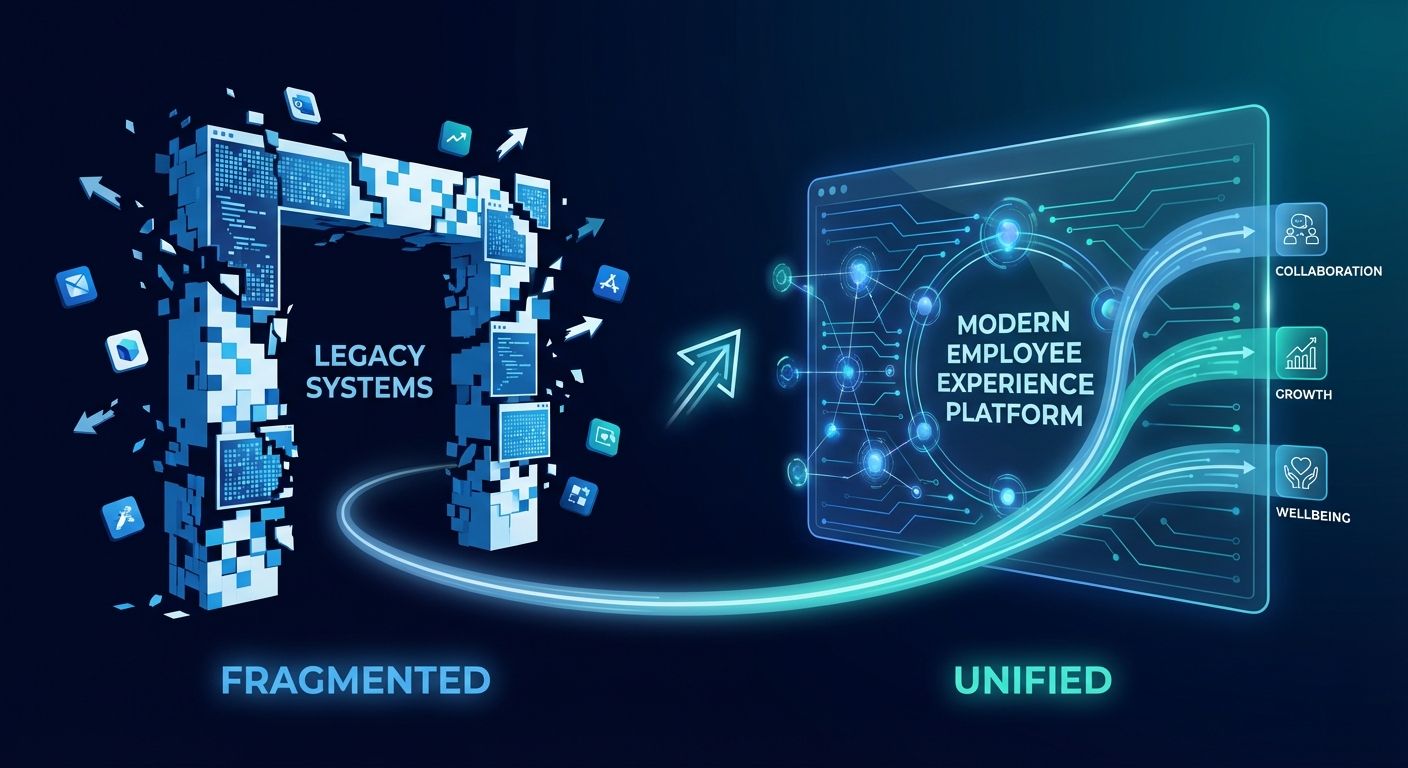
Unified Experience Across Fragmented Tools
The best platforms don't try to replace every application you use. Instead, they become the digital front door: a central hub that integrates seamlessly with your existing tools. Single sign-on, unified search across multiple systems, and consistent navigation that makes sense of complexity rather than adding to it.
Analytics That Actually Drive Decisions
Moving beyond basic page views to understand actual engagement, content effectiveness, and employee sentiment. Which teams are disconnected? What information gaps exist? Where are people getting stuck? These insights transform employee experience from a soft initiative into a measurable business driver with clear ROI.
Personalization at Scale
Every employee sees content relevant to their role, their location, their projects, and their interests. New hires get onboarding journeys. Managers get leadership resources. Frontline workers get operational updates that matter to them, without wading through corporate communications designed for headquarters.
The Path Forward: Evolution, Not Revolution
Here's what I've learned from organizations that have made this transition successfully: You don't flip a switch and suddenly have a modern employee experience platform. It's a journey that requires strategic thinking, phased implementation, and genuine change management.
Start by honestly assessing your current state. Survey employees. Track metrics. Understand where the pain points really are, not where you assume they might be. Often, leadership's perception of "what employees need" differs dramatically from employees' actual experiences.
Build the business case around outcomes, not features. Yes, modern platforms have impressive capabilities. But what matters to stakeholders is reduced attrition, improved productivity, faster onboarding, and better business results. Organizations with effective intranets report 50% or more increases in revenue, profitability, retention, and customer satisfaction. That's the story worth telling.
Secure executive sponsorship early. The most successful implementations have visible leadership support from day one. This isn't an IT project or even an HR project. It's a business transformation that requires cross-functional alignment and genuine commitment from the top.
Prioritize user adoption over feature completeness. A simpler platform that everyone uses beats a feature-rich platform that sits empty. Design with your actual users in mind, test extensively, gather feedback constantly, and iterate based on real behavior rather than assumptions.
The Stakes Have Never Been Higher
Employee expectations have fundamentally shifted. People want purpose and personalization at work. They expect technology that enhances their experience rather than complicating it. They've lived through enough poorly executed digital transformations to be skeptical of half-measures.
Meanwhile, the business environment demands agility, resilience, and the ability to move quickly in response to constant change. Your employee experience platform either enables that velocity or creates friction that slows everything down.
The question isn't whether your organization needs to evolve beyond legacy intranets. The question is how quickly you can make the transition and how thoughtfully you can execute it.
Because here's what I know for certain: The organizations that figure this out will have a profound competitive advantage. They'll attract better talent, retain people longer, operate more efficiently, and adapt more quickly to whatever changes come next.
The organizations that don't? They'll keep losing ground to competitors who recognized that in 2025, employee experience isn't a nice-to-have. It's table stakes for competing in a world where your people are your most valuable asset, and your digital infrastructure either empowers them or holds them back.
The old guard of intranets had a good run. But it's time to build something better. Something that actually serves the modern workforce. Something that treats employee experience as the strategic priority it has become.
The future of work is here. The only question is whether your employee experience platform is ready for it.
Key Statistics Referenced
- Organizations with average-quality intranets are 2.5x more likely to see decreased profitability
- 50% less likely to report productivity gains with poor intranets
- 40% of digital workers use more than 11 applications to do their jobs
- 5% of workers use 26 or more applications
- Employee engagement predicted to drop to 34%
- 87% of companies encourage personal device usage for work
- 26% of organizations struggle with IT resource overreliance
- 74% of organizations plan to implement an EXP by 2025
- Organizations with effective intranets report 50%+ increases in key metrics
About the Author
Sarah Whitman is a thought leader in employee experience and digital workplace transformation at HT Blue.