At its annual Universe conference on October 28 2025, GitHub quietly redrew the map of software development. The announcement of Agent HQ marks a decisive move away from the era of helpful copilots toward a world of orchestrated autonomous collaborators. If the first wave of AI assisted coding was about speed, this next one is about coordination, control, and trust.
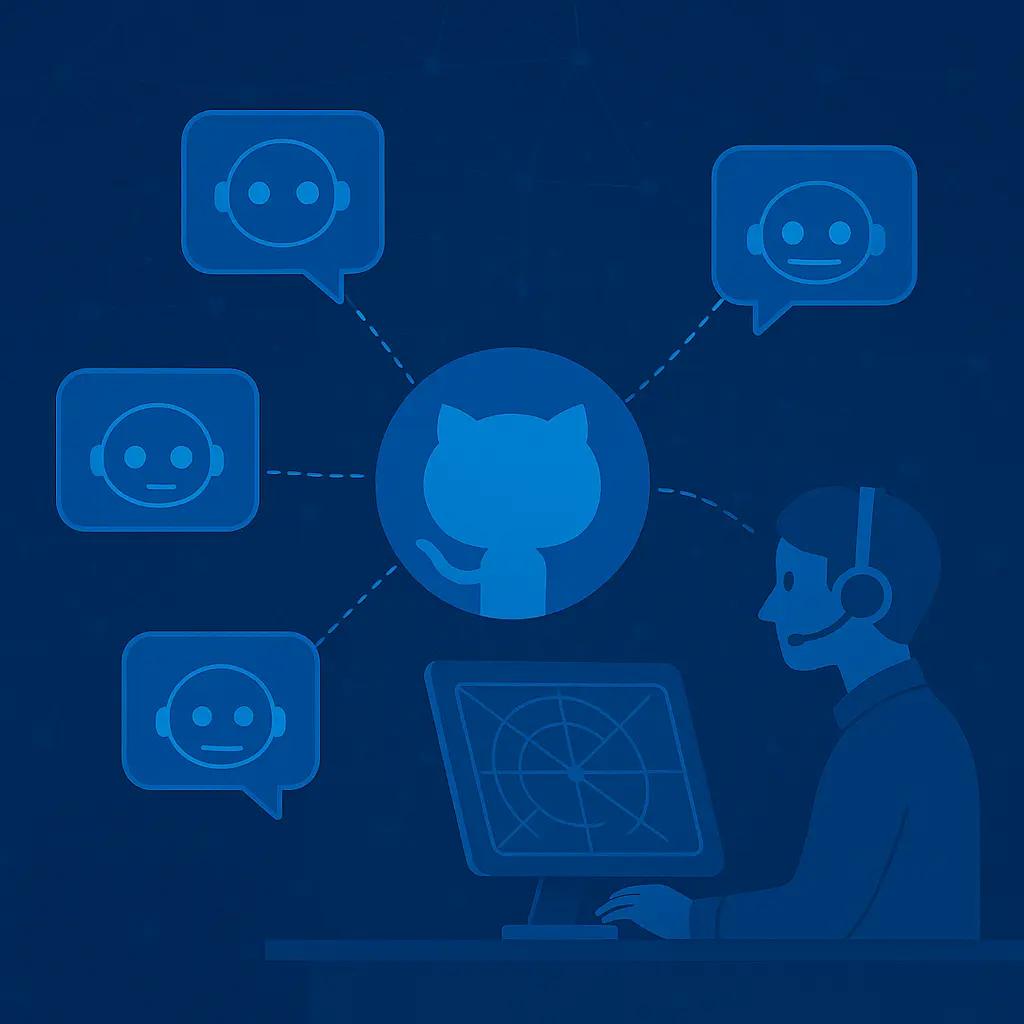
Agent HQ turns GitHub from a code host into what can only be described as a mission control center for developer intelligence. It is where multiple AI agents from OpenAI, Anthropic, Google, Cognition, and xAI report in, receive their orders, and execute them inside GitHub’s secure orbit. The platform is not just integrating AI, it is operationalizing it.
Mission Control: From Code Completion to Code Command
Developers who subscribe to Copilot now gain access to a new dashboard called Mission Control. This interface makes AI collaboration tangible. A developer can assign the same task to multiple agents, compare results, track progress, and select the winner all from one view. It is not pair programming, it is parallel programming at scale.
Each agent runs in a secure GitHub Actions sandbox with no backdoor access to the outside world. Permissions, identity, branch protection, and audit logs all apply. In effect, Agent HQ transforms AI assistants into first class citizens of enterprise DevSecOps, subject to the same scrutiny as human developers.
Codifying the Rules of AI Behavior
One of the most interesting features is AGENTS.md, a configuration file that may become the most consequential markdown file since README. With it, teams can define precisely how agents should act, what they can access, and which standards they must follow. It is the policy manual for machine collaborators, version controlled and auditable.
Clone a repository and the rules follow. The guardrails are not in a corporate wiki, they live beside the code itself. This small design choice could become a quiet revolution in AI governance where behavior is managed as code.
The Rise of the Model Context Protocol
GitHub is also going all in on the Model Context Protocol (MCP), the emerging language of AI tools. MCP allows agents to talk directly to external services through a standard protocol with no custom API glue required. In practical terms this means an agent inside GitHub can call a testing framework, analytics system, or deployment pipeline without breaking security isolation.
The new MCP Registry in VS Code acts like an app store for agentic integrations. Developers can browse, enable, and manage MCP servers just as easily as they install extensions. The effect is subtle but profound. GitHub is becoming not just the home of code, but the home of AI tooling itself.
Planning, Reviewing, and Collaborating with Intelligence
GitHub is introducing new agentic workflows that expand what it means to collaborate with AI. Plan Mode invites a developer to co design a project plan with Copilot before any code is written, ensuring the AI understands the requirements first. Agentic Code Review uses GitHub’s CodeQL engine to let agents audit pull requests for bugs, security flaws, and maintainability issues before a human even sees them.
The result is a workflow that looks less like autocomplete and more like orchestration, with AI and developer negotiating intent, quality, and direction together.
The Strategic Play: From Copilot to Constellation
GitHub’s COO Kyle Daigle described the shift as a move from wave one AI focused on code completion to wave two that is agentic, multimodal, and collaborative. In other words, the Copilot era was about giving every developer a helper. The Agent HQ era is about giving every organization a fleet.
This move positions GitHub as the neutral hub for AI development, an ecosystem where multiple vendors can coexist under consistent governance. It also removes the fear that choosing one model means locking an enterprise into a single provider. In a sense, GitHub is trying to do for AI agents what it once did for open source, making collaboration safe, standardized, and scalable.
What Does This Mean for HT Blue Development
For HT Blue, Agent HQ represents the convergence of two ideas we have been advocating for a long time: AI orchestration and developer trust. Our philosophy has always been that AI should be orchestrated, not worshiped. GitHub’s new framework makes that philosophy practical at scale.
With Agent HQ, we can begin to design AI workflows that are secure, transparent, and version controlled, bringing AI activity under the same governance as human development. The promise is a future where a Sitecore build, an Optimizely integration, or a Sanity deployment can be co managed by multiple agents working in harmony with our engineers, each one specialized, sandboxed, and auditable.
This is the beginning of the true Agentic Development Lifecycle, and it aligns perfectly with how HT Blue sees the next generation of composable experience delivery that is intelligent, orchestrated, and accountable.