What is Microsoft Foundry
The best automation doesn't feel like automation at all. It anticipates what you need, adapts to how you work, and steps aside when you need direct control. This is the promise of agentic frameworks in modern enterprise systems, and it's precisely why Microsoft Foundry has become central to how we build AI orchestration solutions at HT Blue.
When clients ask me to explain Microsoft Foundry, I start with the fundamental shift it represents. We've moved beyond the era of isolated AI models responding to individual prompts. Today's enterprise challenges demand systems where multiple agents collaborate, share context, and execute complex workflows while maintaining the governance and security that regulated industries require.
The Platform That Unifies Agentic AI
Microsoft Foundry is Azure's unified platform-as-a-service for enterprise AI operations, model deployment, and application development. What makes it different from simply deploying models in the cloud is the infrastructure built around those models: multi-agent orchestration, persistent memory, enterprise governance, and seamless integration with the broader Microsoft ecosystem.
The platform consolidates agents, models, and tools under a single management structure with built-in capabilities for tracing, monitoring, evaluations, and customizable enterprise configurations. Role-based access control, networking policies, and security all operate under one Azure resource provider namespace. For organizations already invested in Azure, this means no architectural gymnastics to make AI systems play nicely with existing infrastructure.
Microsoft rebranded Azure AI Foundry to Microsoft Foundry in late 2025, signaling a broader strategic vision. The platform now offers two portal experiences: a classic version for working across multiple resource types and a new streamlined portal optimized for building and managing multi-agent applications. This dual approach reflects the maturation of enterprise AI from experimentation to production deployment at scale.
Why We Chose Foundry for AI Orchestration
At HT Blue, we've evaluated numerous platforms for AI orchestration. Foundry emerged as our primary choice for several interconnected reasons.
First, the model catalog breadth is unmatched. Azure is now the only major cloud offering both Anthropic's Claude models and OpenAI's GPT models alongside hundreds of other options. When we're building solutions for clients, this flexibility lets us select the right reasoning engine for specific tasks rather than forcing a single model to handle everything. GPT-5.2, which became generally available in December 2025, brings enterprise-optimized agentic execution with multi-step logical chains and context-aware planning. Claude's models excel at complex reasoning and healthcare-specific workflows. Having both available through consistent APIs dramatically accelerates our development cycles.
Second, the Microsoft Agent Framework provides the orchestration layer we need without locking us into proprietary patterns. Built on open standards like Model Context Protocol (MCP), Agent2Agent (A2A), and OpenAPI, the framework enables agents to communicate with external systems, hand off tasks to specialized agents, and maintain context across long-running processes. The framework unifies Semantic Kernel's enterprise foundations with AutoGen's research-driven orchestration patterns, giving us production-ready code from what was previously experimental capability.
Third, Foundry Agent Service handles the operational complexity that derails many AI initiatives. Persistent memory, workflow checkpointing, error recovery, and context sharing across agents all work out of the box. We don't spend weeks building infrastructure; we focus on the agent behaviors and business logic that deliver client value.
How Agentic Systems Actually Work
Understanding Microsoft Foundry requires understanding how modern agentic systems differ from traditional AI applications.
A traditional AI application takes input, processes it through a model, and returns output. An agentic system coordinates multiple specialized components that reason about tasks, select appropriate tools, execute actions, and adapt based on results. The agent doesn't just respond; it works toward goals.
Foundry structures this through composable units. Each agent has a specific role, connects to a language model for reasoning, receives instructions defining its goals and constraints, and accesses tools that let it retrieve knowledge or take action. Agents can be prompt-based single units, workflow-orchestrated multi-agent systems defined in YAML, or containerized hosted agents deployed through Foundry's infrastructure.
The Foundry Tools catalog connects agents to more than 1,400 business system connectors, including SAP, Salesforce, and UiPath. Enterprise MCP integration enables secure, authenticated connections to external services. Organizations can also create private tool catalogs for internal APIs, ensuring secure reuse across teams.
Memory capabilities allow agents to retain and recall contextual information across interactions. This isn't simple conversation history; it's structured retention of user preferences, task outcomes, and relationship context that enables truly personalized and continuous experiences.
Real Problems We've Solved with Foundry
Abstract capability descriptions only take you so far. Here's how we've applied Foundry to solve actual client challenges.
Healthcare Documentation Processing
A regional health system came to us drowning in prior authorization workflows. Their clinical staff spent hours daily preparing documentation, reviewing insurance requirements, and assembling evidence for coverage decisions. The manual process introduced delays that affected patient care and created administrative burden that contributed to burnout.
We built a multi-agent system using Foundry that streamlined documentation review and decision support. One agent specializes in extracting relevant clinical information from patient records. Another agent maintains current knowledge of payer-specific requirements and coverage policies. A third agent synthesizes evidence and prepares structured documentation packages.
Claude's advanced healthcare reasoning capabilities, now enhanced with domain-specific connectors through MCP, handle the medical complexity these workflows demand. The system doesn't replace clinical judgment; it eliminates the mechanical assembly work that consumed professional staff time. Initial pilots showed documentation preparation time reduced by approximately 65%, with clinical staff reporting significantly lower administrative burden.
Content Operations Intelligence
A media company managing multiple digital properties struggled with content workflow coordination. Editorial teams worked across disconnected systems. Publishing schedules lived in spreadsheets. Quality control happened through email chains that inevitably dropped context.
We implemented a Foundry-based orchestration layer connecting their existing tools through the Agent Framework's OpenAPI integrations. Specialized agents now monitor content pipelines, flag potential issues before they become problems, and coordinate handoffs between teams. The system maintains memory of editorial preferences, past decisions, and recurring patterns that inform suggestions.
What previously required constant human oversight now operates semi-autonomously, with staff focusing on creative and strategic decisions rather than logistics. The publishing team moved from reactive firefighting to proactive planning.
Enterprise Knowledge Integration
A professional services firm with decades of institutional knowledge locked in documents, presentations, and tribal memory needed that knowledge accessible to their consultants in the field. Previous attempts at knowledge management had produced expensive repositories that nobody used.
Using Foundry IQ alongside custom agents, we built a system that goes beyond simple document retrieval. Foundry IQ reimagines retrieval-augmented generation as a dynamic reasoning process, centralizing RAG workflows into a single grounding API that handles multi-source selection, iterative retrieval, and reflection to improve response quality.
Consultants now query the system conversationally and receive answers grounded in firm expertise, complete with citations and confidence indicators. The agents reason across multiple knowledge sources, synthesize information from disparate document types, and learn from usage patterns to improve relevance over time.
The Governance Question
Enterprise AI adoption consistently stalls on governance concerns. Models can drift. Outputs can be incorrect. Accountability can be unclear. Microsoft's approach through Foundry addresses these challenges directly.
Foundry Control Plane centralizes identity, policy, observability, and security signals for AI developers. Every agent action is logged and traceable. Role-based access control integrates with Microsoft Entra (formerly Azure Active Directory). Content filters provide input and output guardrails. Network isolation options satisfy even stringent regulatory requirements.
The platform includes an AI Red Teaming Agent that systematically probes AI systems to uncover safety risks, integrating with Microsoft Security's PyRIT framework. For industries where AI failures carry regulatory consequences, this built-in safety testing creates accountability that manual approaches cannot match at scale.
Model router capabilities automatically select the best language model for each prompt in real-time, optimizing across performance, cost, and compliance requirements. Organizations can define policies that ensure certain request types route to specific models, maintaining consistency while leveraging model diversity.
Building for the Agentic Future
The January 2026 updates to the AI Toolkit for VS Code signal where Microsoft is taking this platform. Enhanced integration with GitHub Copilot, specialized skills for developing AI agents using Microsoft Foundry, and improved debugging tools all point toward a development experience where agentic systems are as natural to build as traditional applications.
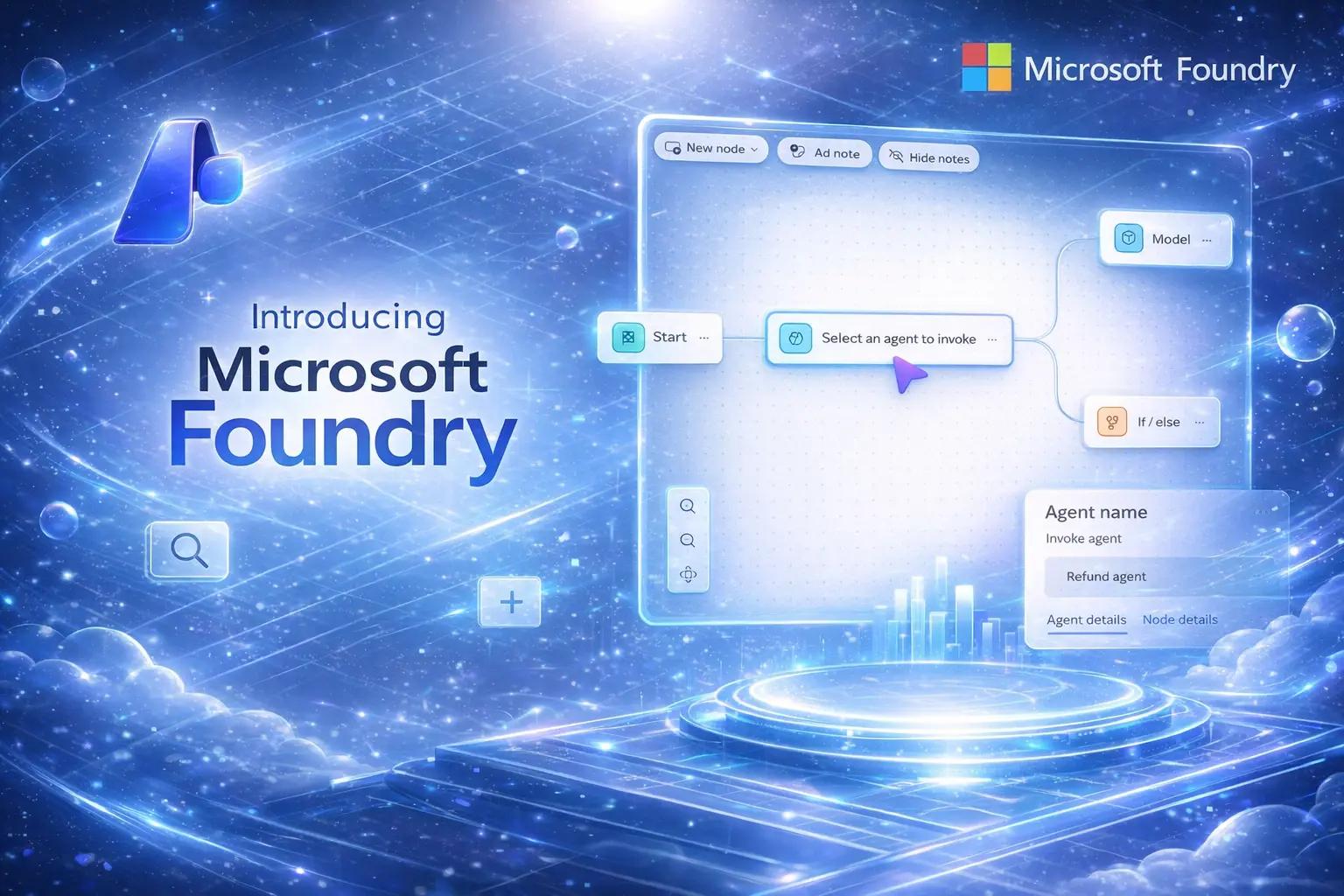
Multi-agent workflows now support visual design through drag-and-drop canvas interfaces alongside YAML definitions for developers who prefer code. Templates inspired by Microsoft Agent Framework patterns accelerate common use cases: sequential workflows, human-in-the-loop approvals, and group chat coordination.
The platform's embrace of open protocols matters for long-term strategy. MCP support means agents built today can connect to the growing ecosystem of MCP-enabled tools and services. A2A protocol support enables cross-platform agent collaboration. Organizations aren't locked into Microsoft's specific implementation patterns.
What This Means for Your Organization
If you're evaluating AI orchestration platforms, Microsoft Foundry deserves serious consideration for several reasons. The combination of model choice, enterprise governance, and Microsoft ecosystem integration creates advantages that compound over time. Early investments in agent-based automation position organizations to scale as the technology matures.
At HT Blue, we've seen that successful AI implementation requires more than technical capability. It requires understanding how intelligent systems integrate with human workflows, where automation adds value versus where it creates friction, and how to build trust in AI-assisted decision-making.
Microsoft Foundry provides the infrastructure. The real work is designing systems that amplify human capability rather than attempting to replace human judgment. That's the philosophy we bring to every engagement, and it's why we've chosen Foundry as our primary platform for building the next generation of intelligent enterprise systems.
The agentic era is here. The question isn't whether your organization will adopt these technologies, but whether you'll adopt them thoughtfully, with architecture that scales, governance that protects, and design that genuinely serves the people who use these systems every day.