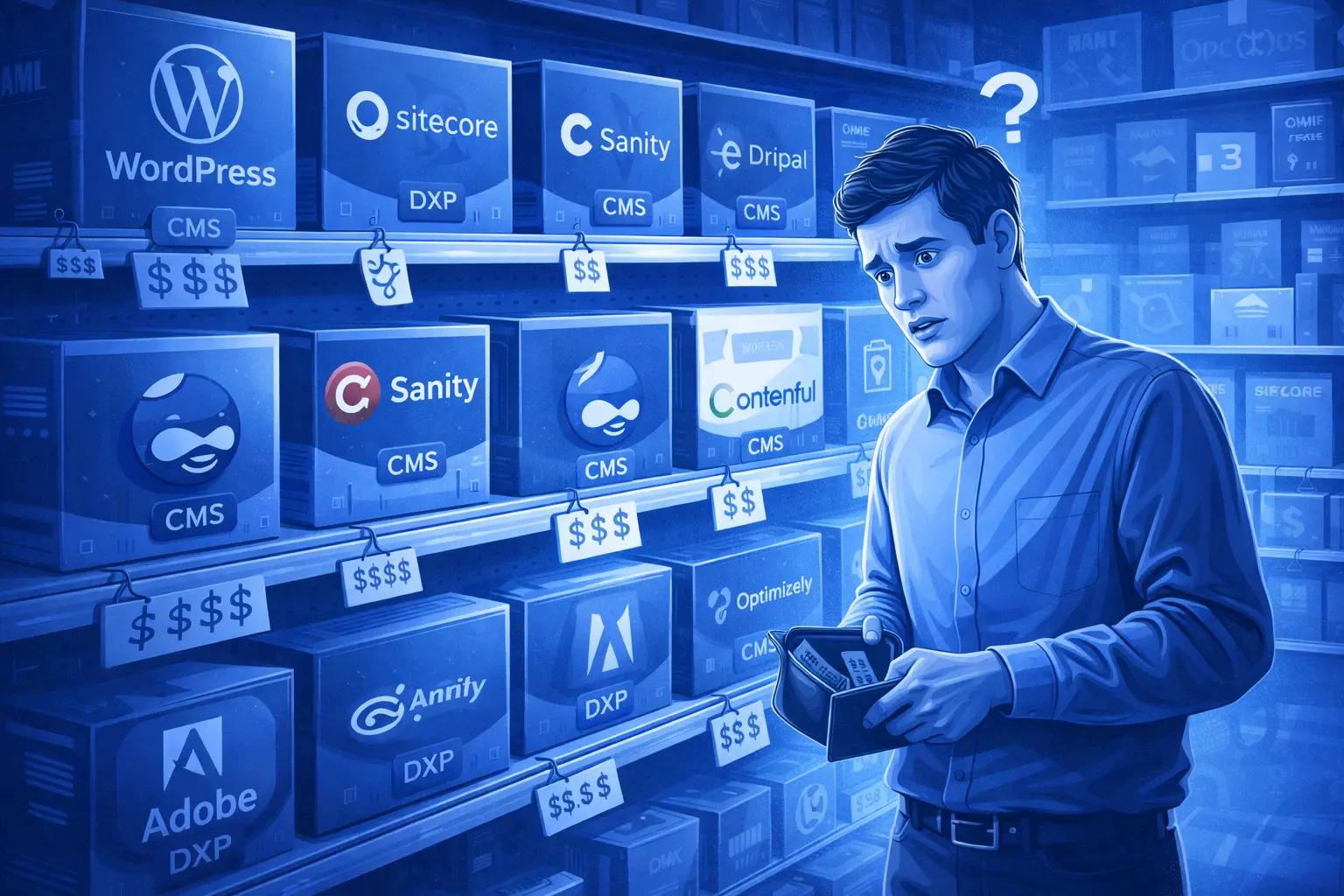
After two decades building distributed systems at scale, I've learned this truth: the size of your organization tells you almost nothing about which platform you should buy.
I've watched 50-person startups successfully run on Adobe Experience Manager because they needed enterprise-grade personalization from day one. I've seen Fortune 500 companies migrate from Sitecore to Sanity because their content operations didn't need a six-figure platform with features they'd never use. The market in 2026 is radically different from even three years ago. The explosion of SaaS headless CMS options has fundamentally changed the pricing conversation.
Here's what you actually need to know about DXP pricing, platform selection, and finding the right fit for your goals.
The Real Cost of Enterprise DXPs: A 2026 Pricing Landscape
Let's start with the hard numbers, because vague "contact sales" pricing doesn't help anyone make informed decisions.
Traditional Enterprise DXPs
Adobe Experience Manager (AEM)
AEM licensing runs from tens of thousands to several hundred thousand dollars annually. The platform uses modular pricing where you pay for specific components:
- AEM Sites (content management)
- AEM Assets (digital asset management)
- AEM Forms
- Cloud service fees based on traffic and compute
Total enterprise implementations typically start around $100,000 annually and can easily exceed $500,000 for global deployments with high traffic. Implementation costs add another $200,000 to $1 million depending on complexity. Adobe requires you to purchase the full Experience Cloud suite to access AEM, which drives costs higher but provides integrated marketing analytics and automation tools.
Sitecore Experience Platform
Sitecore pricing is significantly higher than many organizations anticipate. The platform typically requires $150,000 to $200,000 annually for a three-year contract commitment, and that's just for the core platform license. The composable architecture means you're building your total cost from modules:
- SitecoreAI (formerly XM Cloud for content management)
- Personalize (AI-driven personalization)
- OrderCloud (commerce)
- CDP (customer data platform)
Note that Sitecore recently renamed XM Cloud to SitecoreAI, and Gartner's Magic Quadrant positioning doesn't clearly specify whether they evaluated SitecoreAI or the legacy Sitecore Experience Platform (XP). This matters because the architectures and capabilities differ significantly.
Here's where costs compound: you then need to add frontend hosting. If you're using Vercel or Netlify for your headless frontend, budget another $80,000+ annually. Bringing your own hosting infrastructure costs roughly the same when you factor in DevOps, monitoring, and scaling requirements.
Real enterprise implementations typically run $230,000 to $280,000+ annually when you include platform licensing and hosting. This is before factoring in implementation costs ($150,000 to $500,000) and ongoing development. Both Sitecore and AEM are positioned for organizations with complex personalization requirements, global content operations, and the technical teams to support them.
WordPress VIP
Enterprise WordPress through VIP starts at $25,000 per year with no setup fees or overage charges for traffic. This is WordPress at enterprise scale, built for organizations with:
- Multiple sites and complex setups
- Millions of monthly page views
- Large content teams requiring governance
WordPress VIP includes managed infrastructure, security compliance (including FedRAMP for government), 24/7 expert support, and the flexibility of the WordPress ecosystem. The platform handles everything from content production to headless implementations.
Optimizely (formerly Episerver)
Optimizely is positioned in the top right of Gartner's Magic Quadrant for DXPs, though their report doesn't clearly specify which product variant (PaaS vs. SaaS) is being evaluated. The PaaS DXP offering starts around $100,000 annually and includes composable capabilities for content management, experimentation, and commerce.
Their SaaS DXP offering hasn't gained the same market traction, and pricing structures differ significantly between the two deployment models. Organizations evaluating Optimizely should clarify which architecture they're being quoted for, as the PaaS version remains the enterprise-proven option despite the industry's general shift toward SaaS.
The Modern Headless CMS Explosion
This is where 2026 gets interesting. The headless CMS market has matured into legitimate enterprise alternatives with pricing that makes traditional DXPs reconsider their models.
Contentful
Contentful operates on a tiered model:
- Free: Development and small projects
- Team: Around $300/month
- Enterprise: $5,000 to $70,000+ annually based on API traffic, users, and features
Contentful excels at API-first content delivery with strong localization and multi-space architecture. The pricing scales with usage (API calls, users, content types), which provides flexibility but requires careful monitoring as you grow.
Sanity
Sanity's transparent pricing starts at:
- Free: Generous tier for individuals and small projects (10,000 documents, unlimited API CDN requests)
- Growth: $15 per user/month with scaling quotas
- Enterprise: Custom pricing for advanced security, SSO, dedicated support
What makes Sanity compelling is the pay-as-you-grow model. A 20-person content team on Growth runs $300/month. You can start small, prove value, and scale without renegotiating enterprise contracts. The platform's real-time collaboration, GROQ query language, and developer experience have made it the choice for teams who want structured content without enterprise overhead.
Storyblok
Storyblok pricing:
- Starter: Free for solo developers
- Growth: €99/month (5 users, 400GB traffic)
- Growth Plus: €349/month (15 users, 1TB traffic)
- Premium and Elite: Custom enterprise pricing
Storyblok bridges the gap between visual editing for marketers and headless flexibility for developers. The visual editor makes it accessible to non-technical teams, but the component-based approach can sometimes trap content in presentation-specific blocks.
Hygraph (formerly GraphCMS)
Hygraph pricing starts at $199/month for professional plans, with enterprise pricing based on GraphQL API usage, content federation needs, and scale. It's GraphQL-native, making it powerful for developers building modern applications but steeper learning curve for non-technical users.
Strapi
Strapi is open-source with:
- Self-hosted: Free (you manage infrastructure)
- Strapi Cloud: Starting at $15/month per project
This is the most cost-effective option if you have technical resources to manage hosting and infrastructure. Total control over customization, but you're responsible for maintenance, security, and scaling.
Mid-Market Platforms Worth Considering
Acquia (Drupal Cloud)
Acquia provides enterprise-grade Drupal hosting starting around $141/month for basic plans, with enterprise pricing in the thousands monthly. It's the managed Drupal solution that removes infrastructure headaches while maintaining Drupal's flexibility. Best for organizations already invested in Drupal or needing government compliance (FedRAMP certified).
Bloomreach
Bloomreach positions itself as an agentic platform for personalization with e-commerce focus. Enterprise pricing starts around the same tier as Contentful's upper plans, with costs driven by commerce integration complexity and personalization requirements.
WP Engine
For managed WordPress that's not quite WordPress VIP scale:
- Startup: $25/month
- Professional: $50/month
- Growth: $100/month
- Scale: $242/month
- Enterprise: Custom pricing (thousands monthly)
WP Engine bridges traditional WordPress hosting and enterprise needs, offering staging environments, automated backups, CDN, and 24/7 support. It works for mid-sized sites (10,000 to 100 million visitors) but isn't built for the billions-of-visits scale of WordPress VIP.
Why Organization Size Doesn't Determine Platform Tier
When I led platform engineering at a global tech company, we ran hundreds of sites across every major DXP. Here's what I learned: company size is a terrible proxy for platform requirements.
Small Organizations That Need Enterprise Features
Consider a 30-person fintech startup with complex compliance requirements, multi-region content delivery, and personalization at scale. They need:
- Enterprise security and audit trails
- Sophisticated role-based permissions
- High-availability infrastructure
- Integration with identity providers (SSO)
That startup might legitimately need Sitecore or a headless enterprise platform, not because they're large but because their business model demands it. Their $230,000+ annual platform cost (including hosting) is justified by the revenue model and compliance requirements.
Large Organizations That Don't Need Enterprise Overhead
On the flip side, I've worked with Fortune 500 companies running internal knowledge bases and simple marketing sites. They had 10,000 employees but their content needs were straightforward:
- 5-person marketing team
- 50-100 pages of content
- Quarterly updates
- No personalization requirements
They migrated from an aging Sitecore implementation costing $150,000 annually to Sanity's Growth plan at $1,800/year (12 users). The platform matched their actual requirements instead of their perceived enterprise status.
Matching Platform to Goals: A Framework from Production Experience
After architecting platforms for organizations from 10 to 10,000 people, here's my framework for platform selection.
Match Platform to Content Operations Complexity
Choose Enterprise DXPs (AEM, Sitecore) When You Have:
- 50+ content creators across multiple regions
- Complex approval workflows with 5+ review stages
- Sophisticated personalization (50+ audience segments)
- Multiple brands requiring separate governance
- Deep integration with marketing automation and CRM
- Revenue directly tied to personalization effectiveness
Choose Modern Headless (Contentful, Sanity, Hygraph) When You Have:
- 5-30 content creators
- Omnichannel delivery (web, mobile, IoT, voice)
- Developer-centric organization
- Need for structured content reuse
- Fast iteration and deployment cycles
- API-first architecture requirements
Choose WordPress (VIP or WP Engine) When You Have:
- Content-heavy publishing requirements
- Large plugin ecosystem dependency
- Existing WordPress expertise
- Need for rapid content production
- Traditional page-based content structure
- Budget consciousness with enterprise requirements
Match Platform to Technical Capability
This is where honest assessment matters. I've watched organizations buy Sanity for its developer experience, then realize their team didn't have the technical chops to build custom Studio configurations. I've seen companies choose Sitecore for its marketing tools, then struggle because they didn't have .NET developers.
High Technical Capability (Strong Dev Team):
- Sanity (custom Studio, GROQ queries, structured content modeling)
- Strapi (self-hosted, full customization)
- Hygraph (GraphQL expertise required)
- Headless WordPress (custom frontend development)
Medium Technical Capability (Some Dev Resources):
- Contentful (easier onboarding than Sanity, good APIs)
- Storyblok (visual editor reduces dev dependency)
- WP Engine (managed WordPress, plugin ecosystem)
- Acquia (managed Drupal with support)
Lower Technical Capability (Marketing-Led Teams):
- WordPress VIP (familiar interface, massive ecosystem)
- Sitecore (visual page building, marketing tools)
- Storyblok (WYSIWYG editor, drag-and-drop)
Match Platform to Growth Trajectory
Platform migration is expensive. Pick something that scales with you.
Rapid Growth / Unpredictable Scale:
Usage-based pricing can be friend or foe. Sanity and Contentful let you start small and scale organically, but watch those API request costs. WordPress VIP's no-overage-fee model provides predictability for traffic spikes.
Steady, Predictable Growth:
Enterprise platforms with fixed annual licensing (Sitecore, AEM) provide cost predictability but lock you into contracts. Great if you can forecast accurately; painful if business model pivots.
Experimental / Uncertain:
Start with generous free tiers (Sanity, Strapi, Contentful) and prove the model before committing to enterprise contracts.
The Top Platforms in 2026: Our Recommendations
At HT Blue, we've implemented migrations to nearly every platform on this list. Here are our honest recommendations based on use case, not vendor relationships.
For Enterprise-Grade Personalization and Scale
Sitecore
When to choose: Multi-brand global organizations, sophisticated personalization requirements, Microsoft/.NET stack, e-commerce integration needs.
Why we recommend it: Composable architecture lets you buy only what you need. Strong personalization engine. Proven at enterprise scale. The SitecoreAI offering (formerly XM Cloud) provides modern cloud-native deployment without legacy baggage.
Pricing reality: Budget $150,000 to $200,000 annually for platform licensing on a three-year contract, plus another $80,000+ for frontend hosting (Vercel, Netlify, or equivalent infrastructure). Total annual cost typically runs $230,000 to $280,000+ before implementation. Add implementation costs of $150,000 to $500,000. This is a significant multi-year commitment that makes sense when your business model requires sophisticated personalization at scale.
Adobe Experience Manager
When to choose: Already invested in Adobe ecosystem (Analytics, Target, Campaign), need deep marketing tool integration, have Java expertise, enterprise security requirements.
Why we recommend it: If you're using Adobe's marketing tools, AEM's integration is unmatched. The platform handles massive scale and complex workflows. Strong DAM capabilities.
Pricing reality: Starting at $100,000+ annually, often exceeding $300,000 for full implementations. This is for organizations where content and marketing operations justify the investment.
Optimizely
When to choose: Organizations requiring enterprise-grade experimentation alongside content management, need proven Gartner-recognized DXP, have complex testing and personalization requirements.
Why we recommend it: Positioned in the top right of Gartner's Magic Quadrant. The PaaS DXP offering combines content management with sophisticated A/B testing and experimentation capabilities that are genuinely best-in-class. If optimization and testing are core to your business model, Optimizely's integrated approach delivers value that's hard to replicate with separate tools.
Pricing reality: PaaS DXP starts around $100,000 annually. Their SaaS offering hasn't gained the same enterprise traction. When evaluating proposals, confirm which deployment model you're being quoted, as capabilities and pricing structures differ significantly. Implementation costs typically run $100,000 to $400,000 depending on integration complexity.
For Modern Headless Architecture
Sanity
When to choose: Developer-first organizations, omnichannel content delivery, need for structured content, real-time collaboration, growing teams (5-50 content creators).
Why we recommend it: We've migrated dozens of clients to Sanity and consistently see faster deployment times, better developer experience, and lower total cost of ownership. The GROQ query language is powerful once you learn it. Real-time collaboration is genuinely useful for distributed teams.
Pricing reality: Start at $15/user/month (Growth plan) and scale as you grow. A 20-person team runs $3,600/year. Enterprise pricing is reasonable compared to traditional DXPs. Budget for custom Studio development (typically $20,000 to $100,000 depending on complexity).
Contentful
When to choose: Need proven enterprise headless CMS, strong localization requirements, extensive third-party integrations, prefer established platform over newer entrants.
Why we recommend it: Contentful was first-mover in headless enterprise space and has the maturity to show for it. Strong app marketplace, good documentation, reliable platform.
Pricing reality: Team plans start around $300/month, but enterprise implementations typically run $5,000 to $20,000+ annually. API-based pricing means costs scale with usage.
For WordPress Users Looking to Scale
WordPress VIP
When to choose: High-traffic WordPress sites, need enterprise security/compliance, large content teams, want to stay in WordPress ecosystem, media and publishing organizations.
Why we recommend it: If you're already on WordPress and need to scale, VIP is the right answer. You get enterprise infrastructure, security, and support without abandoning the CMS your team knows. The plugin ecosystem remains accessible. FedRAMP compliance opens government opportunities.
Pricing reality: Starting at $25,000/year with no surprise overage fees. This is predictable enterprise WordPress. Budget another $50,000 to $200,000 for custom development and integration work.
WP Engine
When to choose: Growing WordPress sites not yet at VIP scale, need managed hosting, want performance optimization, 10,000 to 10 million monthly visitors.
Why we recommend it: Solid middle ground between basic WordPress hosting and enterprise VIP. Good performance optimization, automated maintenance, staging environments. Works well for agencies managing multiple client sites.
Pricing reality: $25 to $242/month for standard plans. Enterprise pricing in the low thousands monthly. More accessible than VIP but provides professional managed hosting.
The Real Questions to Ask Before Buying
Based on hundreds of platform evaluations, here are the questions that actually matter:
1. What's Your True Content Volume and Complexity?
Count your actual content creators, not your total employees. A 500-person company might have 8 people creating content. Map your approval workflows honestly. Do you really need 7-stage approval, or is that just what you inherited from the last platform?
2. What's Your Technical Team's Real Capacity?
Be brutally honest. Can your team build custom React components? Do you have backend engineers comfortable with GraphQL? Or is your "technical team" one overworked person who knows just enough WordPress to be dangerous?
I've watched organizations buy Sanity because "we want to be developer-first," then realize they don't have developers. Be realistic about what you can support.
3. What's the Five-Year Cost, Not the Year-One Cost?
Platform costs compound. Include:
- Annual licensing or subscription fees
- Implementation and migration costs
- Ongoing development and customization
- Integration with other systems
- Training and onboarding
- Support and maintenance
- Scaling costs as traffic grows
A $40,000/year Sitecore license becomes $200,000+ total cost of ownership when you factor in implementation, hosting, and ongoing development.
4. What's Your Migration Strategy When This Platform Fails You?
Every platform eventually becomes legacy. Build with exits in mind:
- Can you export your content in standard formats?
- Are you locked into proprietary structures?
- How portable is your frontend?
- What's the vendor lock-in risk?
Headless architectures with structured content (Sanity, Contentful, Hygraph) give you more migration flexibility than monolithic platforms.
The 2026 Market Reality: You Have More Options Than Ever
The DXP market in 2026 is fundamentally different from even 2023. The stranglehold that Adobe, Sitecore, and enterprise platforms had on sophisticated content operations is broken.
A well-architected Sanity or Contentful implementation can deliver enterprise-grade content operations at a fraction of traditional DXP costs. Storyblok and Hygraph provide specialized capabilities that might be exactly what you need. Open-source Strapi gives you unlimited customization if you have the technical chops.
But here's what hasn't changed: bad platform decisions are expensive to reverse. A poorly chosen platform will cost you two years of productivity, hundreds of thousands in migration costs, and team morale.
Our Framework for Platform Selection
After two decades building platforms, here's my honest advice:
Start with your content operations requirements, not your company size.
Map your actual workflows. Count your real content creators. Identify your true personalization needs. Be honest about your technical capabilities.
Match platform capabilities to your goals, not your perceived status.
You don't need Sitecore because you're an enterprise. You need Sitecore if your business model requires sophisticated personalization across multiple brands with complex workflows. If you don't need those capabilities, you're paying for features that sit unused.
Consider total cost of ownership over three to five years.
The $15/user/month Sanity plan looks cheap until you add custom development, integrations, and scaling costs. The $230,000/year Sitecore license (including hosting) looks expensive until you realize it includes capabilities that would cost $200,000+ to build on a cheaper platform.
Prioritize platforms that align with your team's strengths.
A great platform your team can't effectively use is worse than a good platform they understand deeply. WordPress might not be the newest technology, but if your team knows it well, WordPress VIP can deliver better results than a headless CMS your developers struggle to configure.
Plan your exit strategy before you commit.
Structured content and API-first architectures give you migration options. Monolithic platforms with proprietary structures lock you in. Consider the portability of your content investment.
The Bottom Line
Are enterprise DXPs worth the price of admission in 2026? It depends entirely on whether you're buying the platform that matches your actual requirements rather than your perceived organizational status.
A 50-person company with complex personalization needs might legitimately need a $230,000/year Sitecore deployment (platform plus hosting). A Fortune 500 company with straightforward content operations might be perfectly served by Sanity at $5,000/year.
The market has blown wide open. You have options from free open-source platforms to six-figure enterprise solutions. The key is matching capabilities to goals.
At HT Blue, we've migrated organizations in both directions. We've moved small companies onto enterprise platforms when their business model justified it. We've migrated large enterprises to lighter-weight headless systems when the enterprise platform was overkill.
The right platform is the one that serves your content operations today while scaling with your business tomorrow, implemented by a team that understands it deeply, at a price that your business model supports.
Everything else is just marketing.
Pricing Disclaimer: All pricing information in this article is based on customer feedback, publicly available information, and typical negotiated enterprise contracts. Actual pricing varies significantly based on organization size, usage requirements, contract length, and negotiation. Platform vendors typically do not publicly disclose specific pricing details, and the figures provided here represent general market ranges rather than guaranteed costs. HT Blue is not responsible for pricing inaccuracies or changes to vendor pricing structures. Always request detailed proposals from vendors and verify current pricing before making platform decisions.