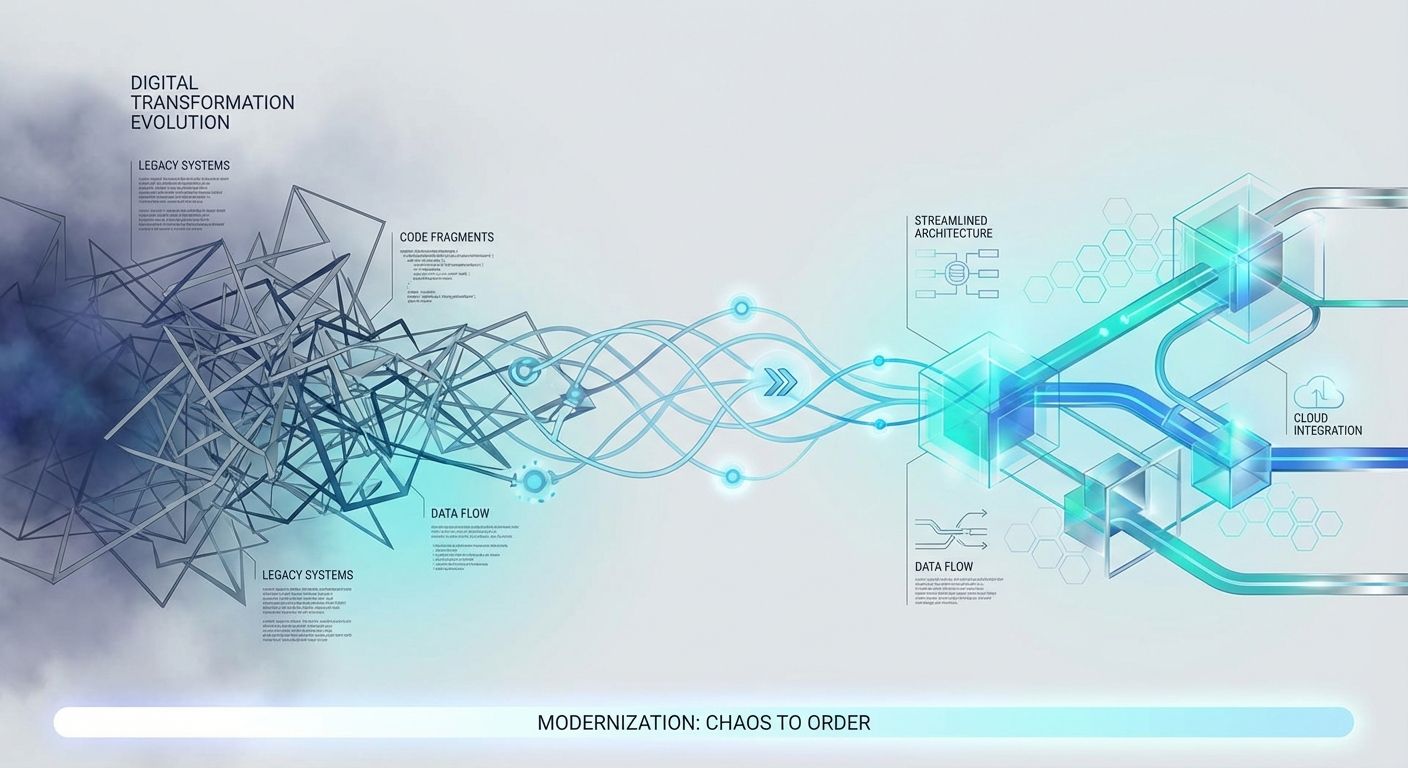
Last quarter, our team at HT Blue wrapped up a comprehensive rebuild and replatform evaluation for a longstanding client still running Adobe CQ5 (now Adobe Experience Manager 6.x). What started as a routine technical assessment turned into an eye-opening examination of how legacy enterprise systems can quietly drain resources while holding digital transformation hostage.
The Context
Our client had been running Adobe CQ5 for nearly a decade. Like many enterprise organizations, they'd invested heavily in the platform during its heyday, built custom workflows around its capabilities, and accumulated significant technical debt along the way. The system worked—sort of. Content publishing happened, pages rendered, and the business continued. But beneath the surface, cracks were showing.
The platform required constant feeding: expensive licensing fees, specialized developer talent commanding premium rates, and an ever-growing maintenance budget just to keep the lights on. When they approached us about modernizing, they weren't even sure if leaving CQ5 was the right move. "We've invested so much already," they said. "Maybe we just need to optimize what we have."
We hear this often. It's the sunk cost fallacy dressed in enterprise clothing.
What the Evaluation Uncovered
Our team spent six weeks conducting a thorough technical and financial analysis. We examined their current CQ5 implementation, interviewed stakeholders, analyzed content workflows, and stress-tested the platform against modern requirements. Then we modeled out what a modern headless architecture could deliver.
The findings were stark:
Developer Productivity: Their CQ5 instance required specialized Java developers familiar with OSGi bundles, JCR repositories, and Adobe's proprietary component model. Finding talent was difficult; onboarding took months. Meanwhile, a modern headless stack using frameworks like Next.js or SvelteKit could tap into a vastly larger talent pool with dramatically faster ramp-up times.
Content Velocity: Content editors were struggling with CQ5's author interface, which hadn't meaningfully evolved in years. Simple tasks like scheduling content or previewing changes across devices required workarounds. Publishing workflows were brittle. A modern headless CMS with a purpose-built editor would slash content production time.
Infrastructure Costs: Running CQ5 meant managing Java application servers, complex caching layers, and significant compute overhead. The system was expensive to host and scale. By contrast, a JAMstack architecture with edge deployment would reduce infrastructure costs by 60-70% while dramatically improving performance.
Time to Market: Launching new features or microsites on CQ5 took weeks or months due to the monolithic architecture. A decoupled system would allow parallel workstreams—frontend teams building experiences while content teams worked independently.
Total Cost of Ownership: When we added up licensing, hosting, development costs, and opportunity costs from slow velocity, the numbers told an unambiguous story. Over three years, migrating to a modern stack would save 40% compared to continuing with CQ5, even accounting for migration costs.
But the most revealing finding was qualitative, not quantitative.
The Innovation Tax
During stakeholder interviews, we noticed a pattern. People kept describing features they'd want "if it were possible" or "if we had time." Build previews of content changes. Real-time collaboration. Flexible content reuse across channels. Personalization that didn't require a consulting engagement.
These weren't exotic requirements. They're table stakes in modern content management. But CQ5's architecture made them prohibitively expensive or simply impossible. The platform had become a ceiling rather than a foundation.
The team wasn't thinking about what they could build. They were thinking about what they could tolerate. That's the innovation tax legacy systems exact: they shift organizational energy from creation to maintenance, from "what if" to "how much will this cost."
The Path Forward
Based on our evaluation, we recommended a phased migration to a headless architecture built on Sanity CMS, Next.js, and Vercel. Not because we're consultants pushing shiny objects, but because the ROI was undeniable and the risk was manageable.
The migration strategy we proposed included:
- Phase 1: Content modeling and migration, with parallel CQ5 and headless systems running simultaneously
- Phase 2: Frontend rebuild, section by section, with no big-bang cutover
- Phase 3: Workflow migration and team enablement, ensuring content teams were comfortable before sunsetting CQ5
- Phase 4: Platform optimization and advanced feature rollout
The entire journey would take 9-12 months, with content velocity improvements visible within weeks and full cost savings realized within 18 months.
Why This Matters
This isn't really a story about Adobe CQ5. It's a story about the hidden costs of technical inertia.
Many organizations are running on platforms that made sense a decade ago but are quietly bleeding value today. The code works. The servers run. The licenses renew automatically. And slowly, imperceptibly, the organization's digital capabilities fall further and further behind what's possible.
The hardest part of our evaluation wasn't the technical analysis. It was helping stakeholders recognize that "we've always done it this way" isn't a strategy—it's an exit plan for competitors who've figured out how to move faster.
What We Learned
Running this evaluation reinforced several lessons our team carries into every replatform conversation:
Listen Before Solving: We came in expecting to validate a headless migration. We spent most of our time understanding how the current system actually worked day-to-day and where pain was most acute.
Show, Don't Tell: Instead of talking about modern DXP capabilities, we built proof-of-concept implementations showing exactly how content workflows would improve. Seeing is believing.
Respect the Investment: The client had poured resources into CQ5. Dismissing that history would have been arrogant and counterproductive. We honored their past decisions while illustrating why the context had changed.
Make It Real: Abstract TCO models are useful, but what moved the needle was showing their team a working prototype where content changes deployed in seconds, not hours, and where developers could iterate without waiting for build processes.
The Bigger Picture
Enterprise technology decisions are rarely about picking the best tool. They're about managing risk, navigating organizational politics, and balancing innovation against stability.
What made this evaluation eye-opening wasn't discovering that modern headless architectures outperform monolithic Java CMS platforms. That's been true for years. What was revealing was watching a smart, capable team realize they'd been tolerating constraints they no longer had to accept.
They'd assumed that enterprise content management had to be this hard, this slow, this expensive. Discovering otherwise changed not just their technology roadmap but their sense of what their digital team could accomplish.
That's what the best replatform evaluations do. They don't just analyze systems. They expand what organizations believe is possible.
If your team is running Adobe CQ5, Sitecore, or any other legacy DXP and wondering whether it's time to reevaluate, we'd be happy to talk through what a modern assessment might uncover. Sometimes the hardest part is just asking the question.
Daniel William, The Arch of the North, writes about digital experience platforms, content architecture, and the messy realities of enterprise technology change.