Let's cut through the marketing speak and talk about what's actually happening with search right now.
If you manage an enterprise website or content operation, you've probably noticed something unsettling: your traffic patterns don't make sense anymore. Pages that should rank well don't. Conversions are down despite solid engagement metrics. And your best content seems to disappear into a void where users get their answers without ever clicking through to your site.
This isn't a temporary blip. According to Gartner, traditional search engine volume will drop 25% by 2026 as users shift to AI-powered answer engines. More than 60% of Google searches already end without a click to any website. For publishers who've built their entire digital strategy around organic search traffic, the numbers are even more stark: some are reporting traffic losses up to 40% after the rollout of AI overviews.
The game has fundamentally changed. And if you're still optimizing exclusively for the "ten blue links," you're fighting yesterday's war.
The Three-Tier Reality of Search in 2026
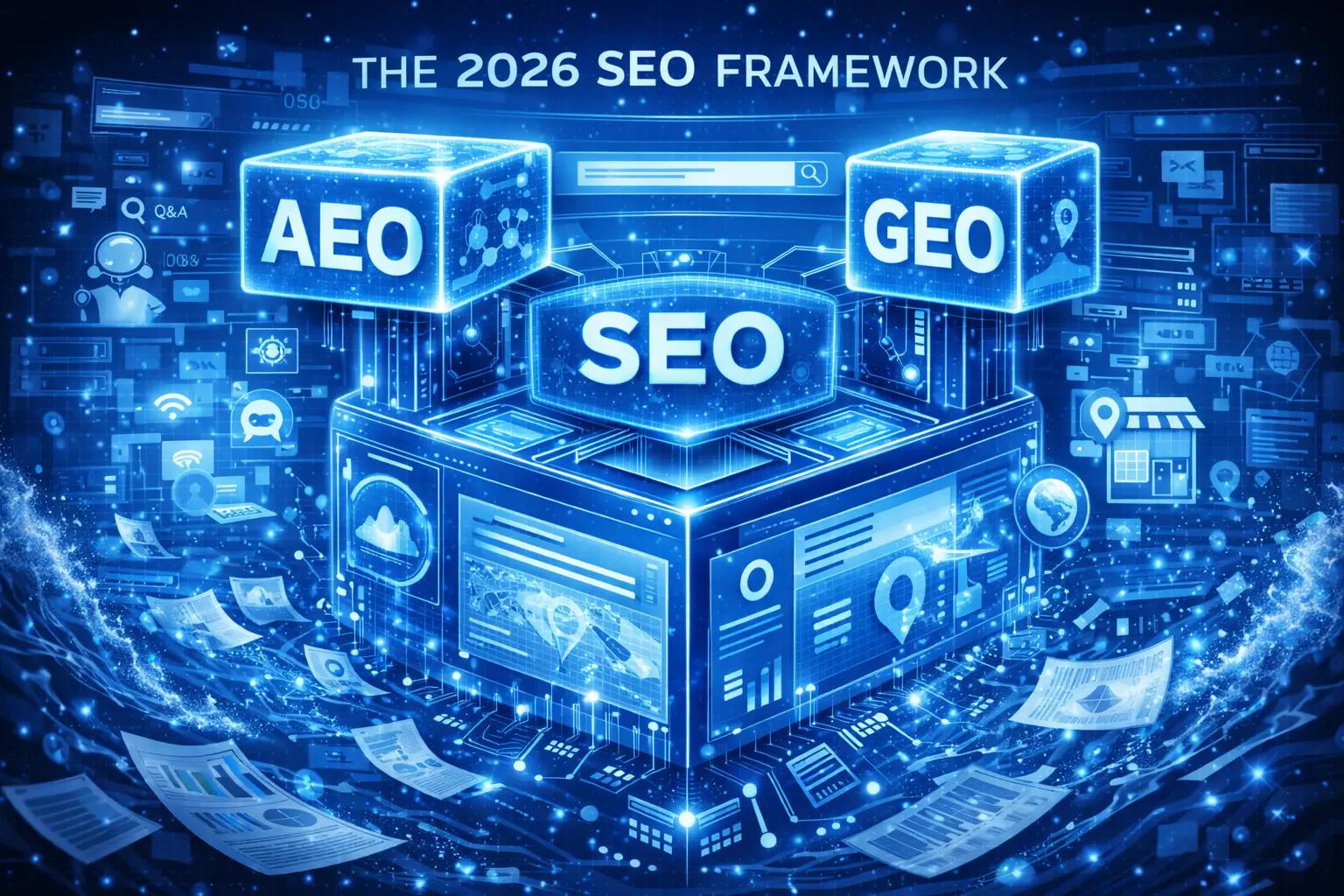
The framework that's emerging isn't replacing traditional SEO. It's layering new requirements on top of it. Think of it as three interconnected strategies that work together:
SEO (Search Engine Optimization) remains the foundation. This is classic technical optimization: fast page speed, mobile responsiveness, crawlability, keyword targeting, backlink building. You still need to rank in search results. Google still commands 86% of U.S. search traffic, and organic visibility still drives discovery for the majority of business websites.
AEO (Answer Engine Optimization) focuses on capturing featured snippets, People Also Ask boxes, and voice search results. This is about structuring your content so search engines can extract and display direct answers without users needing to click through. Over 50% of searches now end at the SERP itself, which means your brand needs visibility even when the click never happens.
GEO (Generative Engine Optimization) targets AI chatbots and large language models like ChatGPT, Claude, Perplexity, Google Gemini, and Microsoft Copilot. This is the newest frontier, and it's growing explosively. ChatGPT alone processes 72 billion messages monthly with over 400 million weekly active users. Analysis of enterprise websites shows AI-sourced traffic from these platforms increased 527% between January and May 2025.
The critical insight: these aren't competing strategies. They're complementary. The same content practices that improve your GEO performance also strengthen your AEO results and reinforce your traditional SEO foundations.
Why This Matters to Your Business Right Now
I've spent the last six months talking to marketing directors, content strategists, and CMOs who are genuinely worried about what this shift means for their businesses. The concerns are legitimate.
When Stack Overflow saw an 18% drop in visits after ChatGPT became popular, it confirmed what many publishers feared: AI answers are cannibalizing traditional search traffic. Developers were getting code answers directly from AI instead of clicking through to the community platform.
But here's what makes this interesting: NerdWallet reported 35% revenue growth despite a 20% decrease in site traffic. How? By ensuring their content and brand expertise still reached consumers through snippets, AI citations, and other discovery channels. They shifted from optimizing for clicks to optimizing for visibility and influence.
That's the strategic pivot every enterprise content team needs to make in 2026. Traffic is no longer the primary metric. Brand visibility, citation frequency, and authoritative positioning in AI-generated answers are becoming more important than page views.
The Zero-Click Economy Is Already Here
The data tells a story most marketing teams aren't prepared for. Research from eMarketer reveals that fewer than 10% of sources cited in ChatGPT, Gemini, and Copilot rank in the top 10 Google organic search results for the same query. Think about what that means: your traditional SEO tactics won't automatically guarantee visibility in AI responses.
AI engines don't just look at keyword rankings and backlink profiles. They evaluate content differently:
- Structured data and schema markup help AI systems understand what your content actually means - Clear, concise answers in the first 100-200 words increase citation probability - Statistics and verifiable data boost credibility (Princeton research shows statistics addition increases visibility 35-40%) - Author credibility and E-E-A-T signals matter more than ever as AI models prioritize authoritative sources - Content freshness gets rewarded (AI systems value "updated 2026" signals and recent timestamps)
The brands winning in this environment aren't gaming algorithms. They're producing genuinely helpful content that AI systems trust enough to cite.
The Five-Step Framework for 2026
Based on what's working for enterprise clients right now, here's the practical framework we're using:
Step 1: Be Found (SEO Foundation)
You still need the fundamentals. Fast site speed, mobile optimization, clean technical architecture, authoritative backlinks, and strategic keyword targeting. Search engines still matter, even as their role evolves.
The difference now: nail the fundamentals quickly so you can focus resources on the newer challenges. Use auditing tools to identify and fix technical issues systematically. Build content clusters around high-intent topics where you have genuine expertise. Own authority with consistent, expert-led content on niche topics.
Step 2: Be Chosen (AEO Strategy)
This is about winning featured snippets, People Also Ask boxes, and voice search results. Optimize for voice queries with natural, conversational question formats. Structure content with clear, question-based headings. Provide concise 40-60 word answers upfront, then expand with supporting details.
Implement FAQ and HowTo schema to help search engines parse your content. Use bulleted lists, comparison tables, and step-by-step formats that AI systems can easily extract. Prioritize clarity and brevity over exhaustive detail.
Step 3: Be Cited (GEO Implementation)
Create content that AI models want to reference. This means high-trust, insight-led material with clear attributions. Publish statistics and original research that AI systems can cite with confidence. Use transparent logic and "how we choose" frameworks that demonstrate your decision-making process.
Build presence on credible sources AI models pull from: industry publications, authoritative blogs, peer-reviewed sources, established media outlets. Use prompt-friendly formatting with semantic HTML, entity tagging, and clear topical relationships.
Step 4: Be Scaled (AI-Assisted Production)
Here's where things get interesting. AI has changed content production economics dramatically. You can now produce more content, faster, while maintaining quality if you approach it strategically.
Automate content production for repeatable formats like product comparisons, FAQs, and how-to guides. Repurpose existing content into multiple formats optimized for different engines. Use AI for editorial planning, clustering, and coverage analysis to identify content gaps.
But here's the critical caveat: using AI to scale low-quality content will backfire. AI engines detect thin, generic, AI-generated content and deprioritize it. The goal is using AI tools to produce more high-value content, not to flood the zone with mediocrity.
Step 5: Be Dominant (Systematic Optimization)
The winners aren't the ones who execute once. They're the ones who optimize continuously, measure systematically, and adapt based on data.
Stack SEO, AEO, and GEO into one unified system. Dominate niche topics with topic-spanning content that addresses search, AI, and conversational discovery. Push traffic into owned channels like newsletters, podcasts, and community platforms where you control the relationship.
Track new metrics beyond traditional analytics: citation frequency in AI responses, brand mentions in answer engines, impression growth for question queries, and referral traffic from AI platforms.
What This Means for CMS and Content Operations
If you're managing enterprise content at scale, this framework has direct implications for your technology stack and workflows.
Content modeling needs to support structure. Your CMS should make it easy to create FAQ sections, comparison tables, step-by-step instructions, and other formats that AI systems prefer. Portable Text, structured content, and modular components become more valuable than ever.
Metadata and schema become critical. You need systematic ways to add structured data, author credentials, publish dates, content types, and entity relationships across your entire content library. Doing this manually doesn't scale. Your CMS should automate schema generation based on content structure.
Content governance requires new rules. Who's responsible for ensuring content is optimized for AI citation? How do you maintain accuracy when AI systems will quote you verbatim? What's your process for updating statistics, refreshing timestamps, and validating claims across hundreds or thousands of pages?
Performance measurement expands. Traditional analytics tracking page views and conversions isn't enough. You need visibility into how your content performs in featured snippets, AI overviews, and chatbot citations. Tools like Search Console, specialized AEO platforms, and AI monitoring services become essential.
This is exactly why we migrated our own content operations to Sanity. The structured content model, flexible schema support, and API-first architecture make it straightforward to implement the technical requirements for SEO, AEO, and GEO simultaneously. We're not constantly fighting our CMS to add schema markup or restructure content for better AI extraction.
The Urgency Is Real, But Don't Panic
Here's the part where I'm supposed to tell you the sky is falling and you need to overhaul everything immediately. But that's not actually true.
Yes, the shift to AI-powered search is happening faster than most marketing teams anticipated. And yes, early adopters of GEO practices are establishing citation advantages that will compound over time. Research suggests that by mid-2026, dominant positions will have calcified around brands that implemented comprehensive strategies in 2024-2025.
But you don't need to abandon your existing SEO program or rebuild your entire content library overnight.
Start with your highest-performing content. Add structured data, create clear Q&A sections, include author bios, update statistics, and add comparison frameworks. Optimize what's already working first. This often delivers quick wins without requiring new content creation.
Then systematically fill gaps with answer-ready content: detailed comparison pages, comprehensive FAQ sections, and how-to guides with step-by-step formatting. Create content specifically designed for AI extraction, not just traditional search ranking.
Measure what matters. Track featured snippet appearances, AI citations, and brand mentions alongside your traditional traffic and conversion metrics. This gives you a complete picture of your search visibility across the evolving landscape.
Most importantly, remember that AI engines prioritize genuinely helpful, accurate, authoritative content. If you're producing that already, you're halfway there. The technical optimization is important, but it amplifies quality content rather than compensating for mediocre material.
The Real Competitive Advantage
After analyzing what's working for enterprise brands that are succeeding in this transition, the pattern is clear: authenticity wins.
The AI-driven strategies delivering results are built on genuine expertise, clear communication, provable facts with proper citations, and real experience that demonstrates authority. Generic AI-generated content optimized for keywords but lacking substance gets detected and deprioritized.
This is actually good news for established brands with real expertise. The barrier to entry for visibility in AI answers is authentic authority, not just technical optimization tricks. If you have genuine knowledge, credible experts on staff, proprietary research, and demonstrated experience in your field, you have sustainable advantages that competitors can't easily replicate.
The framework for 2026 isn't about gaming new algorithms. It's about making your authentic expertise more discoverable, more citable, and more valuable to the AI systems that are becoming the primary discovery layer between your brand and your audience.
Traditional search isn't dead. But it's no longer the only game in town. The sooner your content team embraces the three-tier reality of SEO, AEO, and GEO, the better positioned you'll be to maintain visibility as search continues evolving.
Practical Next Steps
If you're ready to adapt your content strategy for this new reality, here's where to start:
Audit your current state. Run your most important pages through featured snippet checkers and AI citation monitoring tools. See where you're already appearing in answer engines and where you're invisible.
Implement structured data systematically. Start with FAQ schema, Article schema, and Organization schema. Use your CMS to automate schema generation rather than manually adding markup to every page.
Restructure your top-performing content. Add question-based headings, concise answer paragraphs upfront, comparison tables, and bulleted lists. Make the content easier for both humans and AI systems to extract information from.
Create a content calendar focused on answer-ready formats. Dedicate resources to building comprehensive comparison pages, detailed how-to guides, and expert FAQ sections that directly answer the questions your audience is actually asking.
Track the new metrics. Set up monitoring for featured snippet appearances, AI citation frequency, brand mentions in ChatGPT and Perplexity, and referral traffic from AI platforms. Measure what you're trying to improve.
The brands that treat this as an urgent strategic priority while competitors wait and see will capture disproportionate visibility during the critical 2026-2028 transition period. The window for establishing foundational presence in AI-generated responses is open right now.
The question isn't whether to adapt your search strategy. It's whether you'll do it proactively while there's still competitive advantage to be gained, or reactively after your competitors have already established dominant positions.
Your content has value. Make sure AI engines can find it, understand it, and cite it.