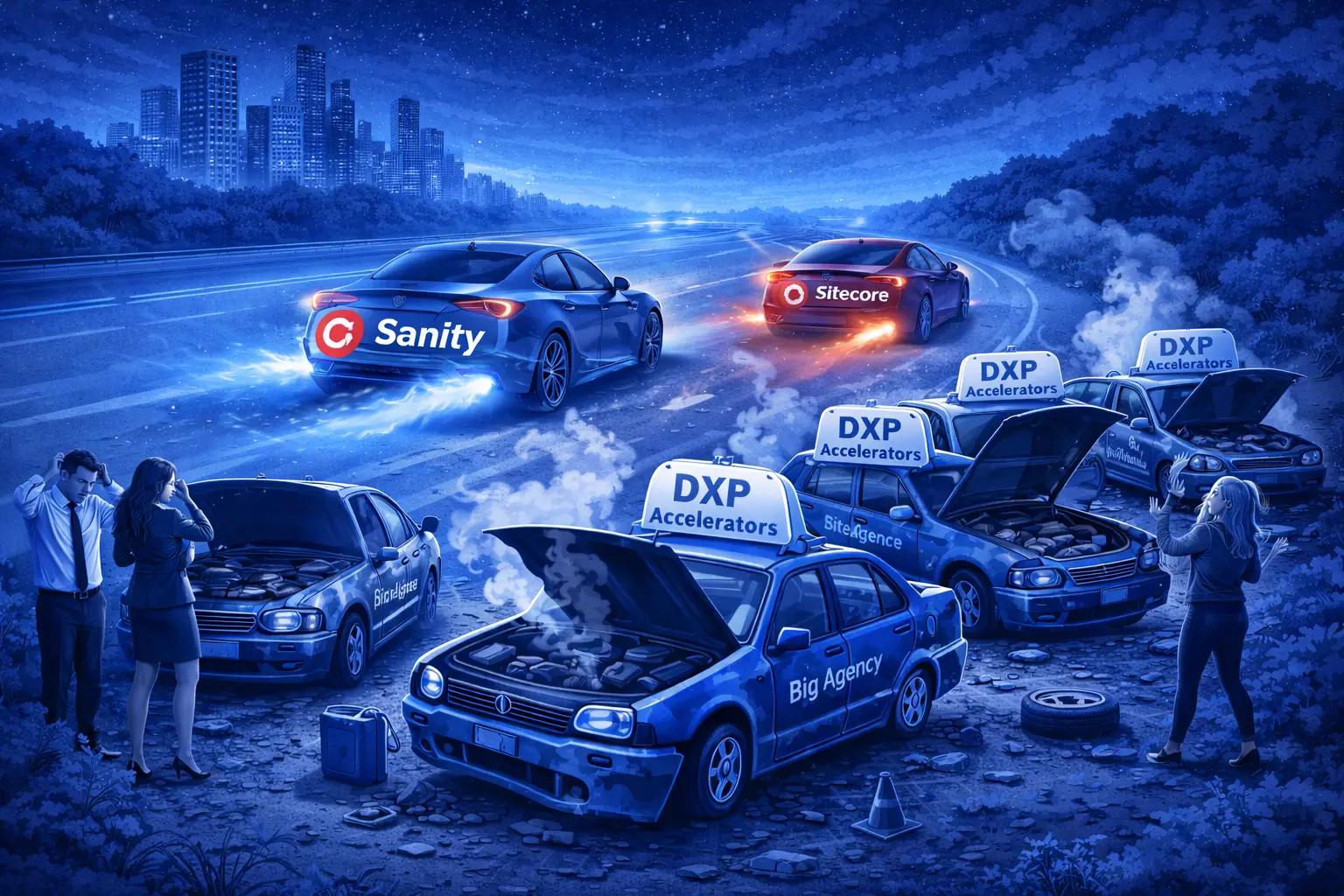
Remember when agencies sold you on their "proprietary accelerators" and "solution frameworks"? Those magic bullet libraries that would get your site live faster and cheaper? That was the pitch. The reality? You're now stuck maintaining someone else's year-old code that was obsolete the day you went live.
Here's the uncomfortable truth the agency model doesn't want you to hear: in modern headless platforms, every line of "reusable IP" you write today is technical debt tomorrow. The platforms are moving too fast. And that expensive accelerator your agency is charging you for? You're not just paying to use code they'll repurpose for your competitors. You're paying for the privilege of being anchored to architectural decisions made before the platform vendor's next breaking change.
When "No More Upgrades" Became a Lie
The whole pitch for SaaS platforms like Sitecore XM Cloud, Sanity, Contentful, and Optimizely was supposed to be liberation from upgrade hell. "Cloud-hosted! No more painful platform upgrades! Focus on innovation!"
Except nobody told you about the other kind of upgrade hell.
Sitecore's JSS to Content SDK Debacle
Take Sitecore. In 2026, they're forcing a migration from JSS to Content SDK, with JSS sunset looming. If you built on an agency accelerator that wrapped JSS (and most did), congratulations. You're now looking at:
- Complete dependency rewrites
- Middleware architecture changes
- Breaking changes to plugin systems
- Experience Editor deprecation requiring workflow adaptation
- Node.js version jumps (now requiring Node 22)
That agency accelerator built 18 months ago? It's now a liability shackling you to an architectural approach Sitecore itself has abandoned. The Content SDK has fundamental structural and architectural changes that make those pre-built libraries incompatible. Your agency's "efficiency" became your anchor.
Sanity's Relentless Evolution
Sanity's better, but only because they move faster. React 19 became required, with React 18 officially deprecated and v5 dropping React 18 support entirely. Studio v4 came with its own breaking changes. Every few months, there's a new presentation tool update, schema validation changes, or workflow feature that requires rearchitecting.
If an agency built you a "schema templating accelerator" for Sanity six months ago, it's probably referencing deprecated patterns. Schema changes are typically breaking changes, and with Sanity's velocity, that pre-built library is already behind.
Contentful and Optimizely: Same Pattern, Different Vendor
Contentful's v12.0.0 brought breaking changes with full ESM support. Optimizely's been on a deprecation spree: CMS SaaS moved elements into blocks with breaking changes requiring package installation, and replaced all PUT endpoints with PATCH in the CMS Preview3 API.
Every single one of these changes invalidates accelerator code. Not because the code was bad. Because the ground underneath it shifted.
The Accelerator Business Model Is Broken
Let's be crystal clear about what an accelerator actually is:
- It's code written for a specific platform version at a specific point in time
- It gets packaged as "reusable IP" that the agency charges multiple clients to use
- You pay licensing fees or hourly rates to implement code that's shared across the agency's client base
- When the platform changes, the agency either abandons the accelerator or charges you again to "upgrade" it
This model made sense in the old world. When Sitecore upgrades happened every 2 to 3 years, you could build an accelerator for Sitecore 8 and get years of value. But in the cloud native, headless world? Platforms are releasing breaking changes quarterly. Your "accelerator" is legacy code before the project goes live.
We've Replaced Enough of These to Know
At HT Blue, we've been called in to rescue more than a few situations where the previous agency's "accelerator" became the blocker. Here's what we've seen:
The "Next.js Starter" That Used Next.js 12
Agency sold a "battle-tested Next.js accelerator" for a Sanity build. Client wanted to upgrade to App Router (Next.js 13 and beyond). The accelerator was hardcoded to Pages Router with custom middleware that broke completely under the new paradigm. Cost to refactor the accelerator: more than building from scratch with modern patterns.
The Sitecore JSS "Framework" That Couldn't Migrate
A financial services client came to us with an agency built JSS accelerator. Custom components, rendering patterns, the works. Sitecore's ContentSDK migration required fundamentally different approaches to metadata integration instead of chromes-based Experience Editor integration. The accelerator's architecture assumed Experience Editor would exist forever. It had to be completely replaced.
The Contentful "Integration Layer" Nobody Understood
The accelerator was a custom abstraction over Contentful's API. When Contentful updated their SDKs, the abstraction broke. The original agency had moved on to other clients. Nobody at the company understood how the middleware worked. The "efficiency" of the accelerator became technical debt that paralyzed development.
The Real Cost: You Pay for Code That Benefits Others
This is the part that should make you angry.
When you pay an agency to implement their accelerator, you're not buying custom code for your business. You're paying to help fund the development of code that will be sold to your competitors. The agency recoups their R&D costs across multiple clients, which sounds efficient until you realize:
- You're paying full rate for code that's already been built and tested on someone else's dime
- The accelerator can't be customized too much without breaking the agency's ability to reuse it
- When the platform changes and the accelerator needs updating, the agency has no incentive to prioritize your project over their other clients using the same code
- If you leave the agency, you're often stuck with proprietary code nobody else knows how to maintain
You're not getting efficiency. You're getting lock in.
How HT Blue Does It Differently
We don't build accelerators. We build with modern tools the way they're meant to be used.
When Sanity releases a schema update, we adopt it. When Sitecore changes their SDK, we learn it. When Next.js ships a new paradigm, we build with it. We don't create proprietary abstraction layers that insulate us from the platform. We embrace the platform's evolution and write clean, maintainable code that follows the vendor's own best practices.
Your code is your code. We don't license you middleware. We don't charge you to reuse patterns we're going to sell to five other clients. We write to the current state of the art, and when the platform evolves, we adapt using the same modern development practices we'd use for any greenfield build.
Our efficiency comes from expertise, not templates. We've done enough Sanity builds that we can scaffold a content model in hours, not weeks. But we're not copying the same schema template across clients. We're applying the right patterns for your specific use case using the current version of the platform.
That's the difference.
Five Questions to Ask Your Current Partner
If your agency is pitching an accelerator, or if you're already using one, challenge them with these questions:
1. "Which version of [Platform] was this accelerator originally built for, and when was that?"
If the answer is more than six months ago, you're inheriting technical debt.
2. "How many other clients are using this same accelerator codebase?"
If the answer is "several," you're paying to subsidize their IP development while accepting their architectural decisions.
3. "When [Platform] releases a breaking change, who pays to update the accelerator, and how quickly will that happen?"
If they can't guarantee timelines or if updates are billable, you're stuck paying upgrade costs while the platform moves on.
4. "If we part ways, can we take the accelerator code with us, and will any other agency be able to maintain it?"
If the answer involves licensing agreements or proprietary dependencies, you're locked in.
5. "Can you show us the current platform vendor's recommended architecture, and explain how your accelerator improves on it?"
If they can't articulate why their abstraction is superior to the vendor's own patterns, they're adding complexity without value.
The Path Forward: Build Modern, Not "Reusable"
The future of DXP development isn't pre-built libraries and proprietary accelerators. It's modern development practices using the platforms as they're designed, with clean architecture that can adapt when the inevitable breaking changes arrive.
Because here's the guarantee: they're coming. Sitecore will change their SDK again. Sanity will deprecate another API. Next.js will ship another paradigm shift. Contentful will restructure their data model. The question isn't whether your stack will need to evolve. It's whether you've built in a way that makes evolution possible.
At HT Blue, we don't make you pay for our "efficiency" by locking you into yesterday's code. We write for today's platforms, we adapt when they change, and your codebase stays modern because we're not maintaining reusable IP across a dozen clients.
That's how it should be.
Want to talk about modernizing a legacy accelerator, or building something right from the start? Reach out to our team at HT Blue. We've seen enough technical debt to know how to avoid creating more.