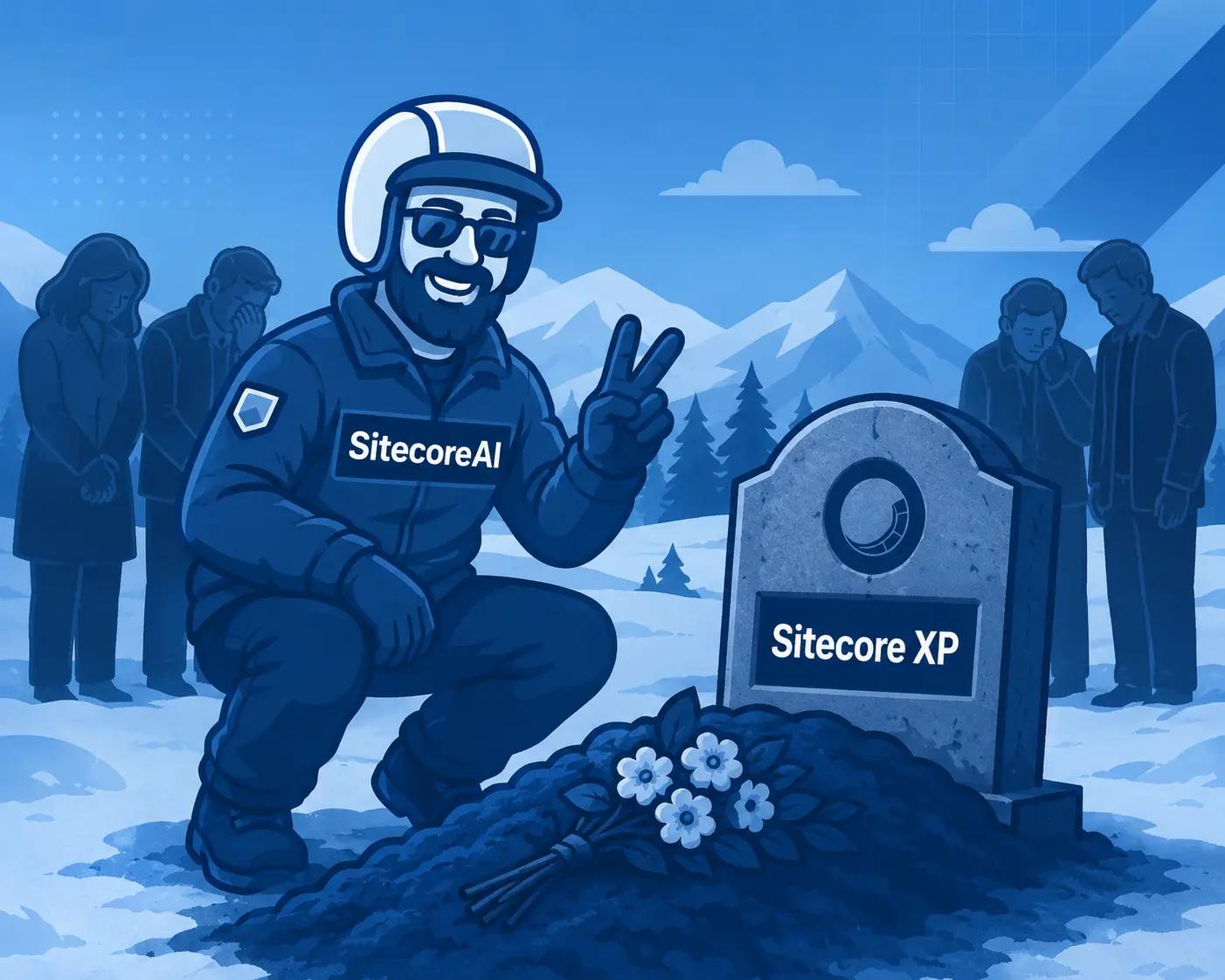
A platform release that was supposed to ship in early 2025 has now been "coming soon" for eighteen months. For Sitecore XP customers planning their next two years, the silence is the story.
The Forest Tells You What Year It Is
Up here in the Adirondacks, you learn to read the woods by what's missing. A pine that hasn't put on new growth in three seasons isn't dying, exactly, but it's also not the tree it used to be. Something has changed in its relationship with the soil. You can tell from the spacing of the needles, the color at the tips, the way the bark holds.
I've been watching Sitecore Platform DXP with the same patient attention for a while now, and the rings are getting closer together.
Sitecore XP 10.5 was originally scheduled for early 2025. That date came from Sitecore's own communications around the 10.4 release and was reaffirmed at SUGCON Europe 2025 in Antwerp, where Chief Product Officer Roger Connolly told the room that 10.5 was "coming soon." Konabos covered the keynote in April 2025 and reported the same. Eighteen months later, as I write this in May 2026, 10.5 has not shipped.
That, by itself, is not a scandal. Software slips. Enterprise software slips more than most. What's worth examining is the pattern of what has and hasn't happened since the original commitment, because the pattern tells you something the press releases do not.
What Actually Shipped in the Last Two Years
Let's take inventory.
In April 2024, Sitecore shipped XP 10.4 with roughly 200 customer-requested fixes, accessibility improvements, the Sitecore Connect xConnect integration, and updated third-party compatibility. It was a solid release, and Sitecore's own positioning called it "renewing its vows" with the XP customer base. Mainstream support was extended to the end of 2027 with extended support through 2030.
In June 2025, Sitecore quietly released 10.4 Update-1. The Konabos team called it "a very quiet drop." The release notes covered Solr 9.8.1 compatibility (the older 8.x had gone end-of-life a year earlier), Identity Server on .NET 8, encrypted SQL Server communication by default, and assorted security patches. Useful work. Necessary work. But maintenance work, not new platform capability.
At Sitecore Symposium 2025 in Orlando, the November keynote announced that XM Cloud was being absorbed into a new unified product called SitecoreAI, which would roll out on November 10, 2025. CEO Eric Stine (who replaced Dave O'Flanagan in May 2025 after O'Flanagan's one-year tenure) framed it as the most significant launch in Sitecore's history. The press, with some justification, agreed.
On the Platform DXP side, the most candid session of Symposium came from Vignesh Vishwanath and Maxim Sidorenko. They presented a "strangler pattern" modernization strategy for XP, the gradual replacement of the legacy .NET Framework stack with a new system built around it on .NET Core. Strangler pattern is a well-respected approach. Martin Fowler wrote about it twenty years ago. It works.
But here's what was conspicuously absent from Symposium 2025: a release date for 10.5. A feature list for 10.5. A demo of 10.5.
What was presented instead was a roadmap that loosely aligned future XP releases with .NET 10 (Microsoft's next LTS, supported through November 2028) and a vision for incremental modernization. That's not a 10.5 announcement. That's a description of how 10.5, whenever it ships, will probably look different from what was promised at SUGCON 2025.
The Support Model Changed Underneath Everyone
While we were all watching the SitecoreAI launch, something else moved.
Sitecore changed its support model effective June 1, 2026. As Fishtank documented in March, production incident support and security updates now require a separate paid arrangement for any version in Extended Support. Until that date, both were included as part of the standard agreement. The change doesn't affect Mainstream Support, where 10.4 lives through end of 2027. But it does affect anyone on 10.0 through 10.3, which collectively is still a substantial portion of the installed base.
If you're running 10.0 or 10.1, your Extended Support ends December 31, 2026. After that, you drop to Sustaining Support, where security patches are not available at any price.
I'm not flagging this to alarm anyone. The dates have been published. Sitecore has been transparent about the lifecycle policy. But layered against the missing 10.5, the picture starts to clarify: customers on older XP versions have a narrowing window to upgrade, the only Mainstream-supported XP version is 10.4, and the next version that was meant to give them somewhere to go has not arrived.
What the Silence Probably Means
I've watched a lot of enterprise software companies navigate this transition. The pattern is familiar. When a vendor's strategic investment shifts to a new product line, the legacy platform doesn't die in a press release. It dies in a release schedule.
This is not me predicting that XP is going away. Sitecore has been explicit, in writing, that they will support 10.4 deployments for the next decade. That commitment is real, and the company has the capital backing to honor it. EQT's $1.2 billion investment in 2021 funded the SaaS pivot, and customer migration to SitecoreAI is happening on a meaningful but not catastrophic timeline.
What I am saying is that 10.5, as a product release, appears to have quietly transformed into something else. The Symposium 2025 strangler pattern session, read carefully, describes a multi-year incremental modernization rather than a single point release. That's a different shape of work, and a different shape of customer commitment, than what "10.5 in early 2025" implied.
The honest read is that Sitecore is doing what most vendors in this position do: keeping the legacy platform stable and supported, channeling new feature development to the SaaS product, and modernizing the underlying stack of the legacy platform on a timeline that aligns with .NET Framework's own end-of-life pressure rather than competitive feature parity with SitecoreAI.
For Sitecore, that's a defensible business decision. For Sitecore XP customers, it changes the math on the next 24 months.
What This Means If You're an XP Customer Right Now
I want to be careful here, because the right answer depends heavily on which version you're running, what xDB investments you've made, and what your appetite is for migration versus modernization in place.
A few patterns I'm seeing across enterprise XP implementations:
Organizations on 10.4 are in the most comfortable position. Mainstream support runs through end of 2027, extended through 2030, and a decade of paid support is available beyond that. There is no operational urgency. The question for these customers is strategic, not tactical: when does it make sense to migrate to SitecoreAI, what does the migration cost, and what business value does the migration unlock that 10.4 cannot deliver. Those are real questions, but they don't have a 2026 deadline.
Organizations on 10.0, 10.1, or 10.2 have a harder conversation ahead. The cost economics of Extended Support changed in June 2026, and the security patch availability is finite. The choice for these customers is upgrade to 10.4, which is technically straightforward but not free, or use this moment to evaluate migration to SitecoreAI, or to evaluate alternative platforms entirely. The independent DXP Scorecard at dxpscorecard.com provides side-by-side comparisons against Optimizely, Adobe Experience Manager, Contentful, and others if you want a vendor-neutral starting point. Sitecore XP and SitecoreAI both have their own platform profiles.
Organizations on 9.x are out of options on the support track. The conversation is now about migration timing and migration destination, not whether to migrate.
In all three cases, the absence of 10.5 changes the calculation. If 10.5 had shipped on time with significant new capability, it would have given XP customers a reason to stay on the platform line. Its absence sends the opposite signal: the future of Sitecore investment is SitecoreAI, and the future of XP is stability rather than growth.
What I'd Watch For
If 10.5 ships in the second half of 2026, look closely at what's in it. If the release is .NET 10 alignment, security and compatibility updates, and incremental Stream integration, that confirms the strangler pattern interpretation. If it includes substantial new platform capability, the picture changes.
If 10.5 doesn't ship at all in 2026, and instead Sitecore announces a renamed or restructured Platform DXP roadmap, that's worth a longer conversation. It would suggest the strangler pattern modernization has effectively replaced the conventional point-release cadence.
Either way, the platform you built on five years ago is not the platform you'll be running five years from now. That's true of every enterprise CMS. It's been true since the first version of Sitecore I worked with back in the early 2000s. The job for those of us who plan these deployments is to read the rings honestly and choose accordingly.
The trees keep growing. The forest changes shape. The work continues.
Practical Takeaways
A few things worth doing in the next quarter if you're running Sitecore XP:
Check which version your production deployment is actually running. The answer is more often "we're not sure" than anyone wants to admit.
Verify your support tier and the dates that apply to it. The June 2026 support model change affects more customers than have realized.
Ask your Sitecore account team for a current 10.5 release date in writing. The answer you get, or the answer you don't get, is informative.
Evaluate SitecoreAI on its current merits rather than its launch positioning. The platform has been in production since November 2025 and is no longer the marketing concept it was at Symposium.
Consider an independent platform assessment if your roadmap horizon is longer than two years. dxpscorecard.com is one starting point. Gartner's DXP Magic Quadrant is another, though it focuses on vendors with revenue thresholds north of $20 million.
The platform decision you make in 2026 will outlast the leadership team that's making promises about it today. Plan accordingly.