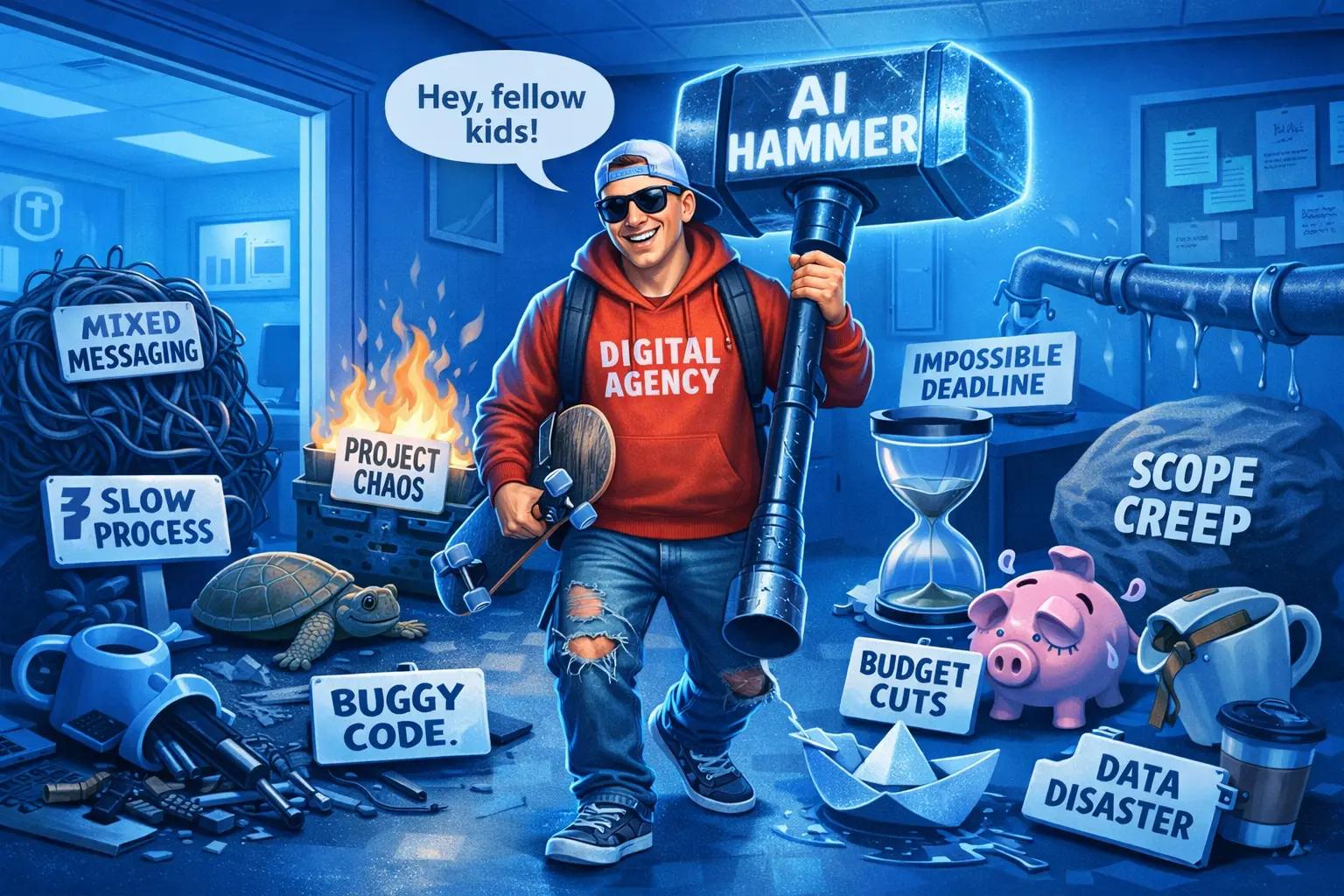
Every Digital Agency Has an AI Hammer and They're All Looking for Nails
By Marla Quinn, Marketing Director at HT Blue
Walk into any digital agency pitch these days and you'll hear the same thing: "We're AI-first." "We've built our proprietary AI framework." "Our AI solution can transform your business."
Then they pull out their hammer and start looking around your organization for things that look like nails.
Here's the problem: client problems aren't nails. They're complex, messy, context-dependent challenges that require specialized tools, deep understanding, and often solutions that have nothing to do with AI.
But when your entire value proposition is built around an AI hammer, everything starts to look like something you can hit.
I've watched this play out dozens of times over the past two years. Digital agencies that spent 2022 doing traditional web development and marketing are now "AI-first" agencies with "proprietary AI pipelines." They've built their hammer. They've polished it. They've put it in their pitch deck.
And then they sit back and wait for clients to line up with nail-shaped problems.
Spoiler: They don't.
Why Digital Agencies Keep Building the Same Hammer
This isn't about AI startups or technology companies. This is about traditional digital agencies—the ones doing WordPress sites and marketing campaigns in 2022—suddenly declaring themselves "AI-first" in 2024.
The pivot makes business sense. AI is the buzzword. Clients are asking about it. Competitors are claiming it. So agencies build one AI pipeline, one framework, one "proprietary approach" and rebrand their entire practice around it.
The Rebranding Trap
When you've spent 15 years as a digital marketing agency, you can't suddenly claim deep expertise in supply chain optimization or healthcare data analytics. So instead of developing domain expertise, you develop a tool. A hammer. Then you take that hammer to every client conversation and hope their problem looks nail-shaped enough.
The One-Pipeline Fantasy
Here's what these agencies tell themselves: "If we build a solid AI pipeline for content generation, we can apply it to marketing, documentation, customer service, internal comms..."
This is like saying "we built a solid hammer, so we can do carpentry, plumbing, electrical work, and surgery."
Client problems don't work that way. The AI solution for analyzing medical imaging data is fundamentally different from the AI solution for optimizing ad spend. Different data structures. Different accuracy requirements. Different integration points. Different success metrics.
But that nuance doesn't fit in a pitch deck, so agencies build one hammer and hope for the best.
The Justification Problem
Once you've invested in building your AI framework, you need to justify that investment. Every client conversation becomes an opportunity to deploy your solution. Your team is trained on it. Your margins depend on it. Your positioning requires it.
So you stop asking "what does this client need?" and start asking "how can we apply our AI framework here?"
That's when client problems become nails.
Why the Hammer Approach Fails Every Time
When you only have an AI hammer, client problems start looking distorted.
Different Problems Need Different Tools
Your content generation pipeline might work great for blog posts. But that same pipeline applied to legal compliance documentation? Disaster. Applied to technical API documentation? Worse. Applied to crisis communications? Dangerous.
Each of these requires different accuracy thresholds, different review processes, different integration points, different success criteria. But if you've only built one hammer, you convince yourself they're all just different types of nails.
They're not.
The Square Peg Problem
I've watched agencies spend weeks trying to force their AI solution into a client problem it was never designed to solve. The client needs better workflow orchestration across departments. The agency keeps pitching their content generation tool because that's what they built.
The client needs data validation and quality control. The agency pitches sentiment analysis because that's their hammer.
Eventually the client either walks away or—worse—buys the wrong solution because the agency was convincing enough. Six months later, they've paid for a tool they don't use and their actual problem remains unsolved.
The Integration Fantasy
"Don't worry, our AI pipeline can integrate with your existing systems."
No, it can't. Not meaningfully. Not without understanding how those systems work, what data they contain, how your teams actually use them, and what your business processes require.
But admitting that would mean admitting your one-size-fits-all AI pipeline isn't actually fit for this particular purpose. So agencies hand-wave the integration challenges and hope the client doesn't notice until after the contract is signed.
You're Solving the Wrong Problem
Here's the worst part: often the client doesn't even have an AI problem. They have a process problem. A training problem. A communication problem. An organizational alignment problem.
But when you're an "AI-first" agency with an AI hammer, you can't say that. Your entire value proposition depends on AI being the answer. So you jam AI into the solution even when it makes things worse.
You've automated the wrong thing. You've added complexity where simplicity was needed. You've created a dependency on a tool that solves a problem the client never had.
Congratulations. You used your hammer. The client still has their original problem, plus a new expensive AI tool they don't know what to do with.
The Hard Truth About Specialized Tools
Every client problem is different. They require different tools, different approaches, different expertise.
A healthcare provider struggling with patient data documentation needs specialized understanding of HIPAA compliance, clinical workflows, and medical terminology. The AI solution here—if there even is one—looks nothing like the AI solution for a retailer optimizing inventory predictions.
Different data models. Different accuracy requirements. Different integration challenges. Different regulatory constraints. Different success metrics.
You can't build one AI pipeline and apply it to both. That's not how problems work. That's not how solutions work.
But understanding the specific nuances of healthcare operations? That takes years. Understanding retail supply chain complexities? Also years. Understanding financial services compliance? Years again.
So instead of doing that hard work, agencies build one hammer. They get good at swinging it. They hope client problems are nail-shaped enough that nobody notices the mismatch.
What Specialized Tools Actually Require
Understanding these problems demands:
- Deep domain expertise in the client's industry
- Knowledge of regulatory environments and compliance requirements
- Familiarity with existing systems and vendor ecosystems
- Understanding of organizational politics and decision-making processes
- Experience with similar problems in similar contexts
This takes time. It requires humility. It means admitting when AI isn't the answer. It means building relationships before building solutions.
It's the opposite of "we're AI-first" positioning. It's problem-first. Sometimes that leads to AI solutions. Often it doesn't.
But agencies that have already invested in their AI hammer can't afford that honesty.
Problem-First, Then Maybe AI
Agencies that build sustainable practices don't start with their hammer. They start with problems. Real, specific, well-understood problems.
"We've worked with five healthcare systems this year. They all struggle with clinical documentation accuracy during shift changes. The issue isn't technology—it's that nurses are documenting in one system, physicians in another, and information gets lost in translation."
Now you understand the problem. Now you can evaluate solutions. Maybe AI helps with automated documentation extraction. Maybe it doesn't. Maybe the solution is better process design. Maybe it's system integration. Maybe it's just training.
But you don't know until you understand the problem deeply.
The Right Sequence
- Understand the problem - What's actually happening? Why is it happening? What have they tried? What constraints exist?
- Evaluate potential solutions - What approaches might work? What are the tradeoffs? What specialized tools or expertise does this require?
- Consider if AI fits - Does this problem benefit from AI? Which AI approach? What accuracy threshold is required? How does it integrate? What are the risks?
- Recommend honestly - Sometimes AI is perfect. Sometimes it's one piece of a larger solution. Sometimes it's completely wrong for this problem.
Notice where AI appears in that sequence? Third. After understanding. After evaluation. Not first. Not as the predetermined answer.
Stop Jamming AI Down Client Throats
When you lead every conversation with your AI capabilities, you're doing it wrong. You're making the client fit their problem to your solution instead of fitting your solution to their problem.
Real expertise means knowing when not to use the tool you're best at. A surgeon doesn't start every patient consultation by explaining their surgical technique. They diagnose first. Sometimes surgery is the answer. Often it's not.
The same applies to AI. If you're an "AI-first" agency, you've already committed to surgery before examining the patient.
The Uncomfortable Truth About "AI-First" Agencies
Most agencies declaring themselves "AI-first" aren't really AI experts. They're traditional digital agencies that added AI to their service menu and put it at the top of the pitch deck.
They built one hammer. They got good at swinging it. Now every client problem looks like something they can hit.
The Difference
Real problem-solving firms—the ones building sustainable businesses—develop deep expertise in specific domains first. Healthcare operations. Financial services compliance. Supply chain logistics. Enterprise content management.
They understand these domains so well they can spot patterns across clients. Predict challenges before they emerge. Recommend solutions that actually fit the context.
Sometimes those solutions involve AI. Sometimes they involve process redesign. Sometimes they involve better training. Sometimes they involve acknowledging that the client doesn't actually have the problem they think they have.
They're not religious about AI because their value proposition isn't built on a specific tool. It's built on understanding.
The Toolbox Approach
When you're a problem-solving firm, AI is one tool in a comprehensive toolbox. You also have:
- Process optimization expertise
- Change management capabilities
- System integration knowledge
- Vendor evaluation frameworks
- Industry-specific compliance understanding
- Organizational design experience
You pull out the right tool for the specific problem. Sometimes that's AI. Often it's not. The client doesn't care about your tools—they care about solving their problem.
But when you're an "AI-first" agency? You've already decided which tool you're using before you understand the problem. That's not consulting. That's sales.
How to Actually Build a Sustainable Practice
If you're running a digital agency that's pivoted to "AI-first," here's the uncomfortable truth: you need to reverse your entire approach.
Put down the hammer. Stop building AI pipelines looking for problems. Stop pitching your AI capabilities first. Stop framing every client conversation around the tool you've already built.
Build domain expertise instead. Pick an industry. Pick a problem space. Become the expert in that, not in AI. Learn healthcare operations. Understand financial services workflows. Master supply chain logistics. Develop expertise in enterprise content strategy.
When you understand the domain deeply, you can spot real problems. You can predict challenges. You can evaluate solutions properly. Sometimes that leads to AI. Often it doesn't.
Develop a real toolbox. AI should be one tool among many, not your only tool. Build capabilities in:
- Business process optimization
- Change management and organizational design
- System integration and vendor evaluation
- Compliance and regulatory navigation
- Data governance and quality control
Then you can pull out the right tool for each specific problem instead of forcing every problem to fit your one tool.
Lead with questions, not solutions. Stop telling clients what they need before you understand their context. Start asking:
- What's actually happening in your operations?
- Where are the breakdowns occurring?
- What have you already tried?
- What constraints are you working within?
- What does success look like for your organization?
Listen to the answers. Actually listen. Don't translate everything you hear into "here's how our AI solution fixes that."
Be honest about fit. When AI isn't the right answer, say so. When a client's problem requires tools or expertise you don't have, say that too. Recommend what they actually need, even if that means referring them elsewhere.
This builds trust. This creates relationships. This leads to sustainable business.
Stop measuring AI deployment. Start measuring problem understanding. Track:
- How accurately can you predict client challenges?
- How often do your solutions actually solve the stated problem?
- What's your client retention after implementation?
- How many referrals come from successful engagements?
These metrics tell you if you're building a real consulting practice or just trying to sell hammers.
Put Down the Hammer
The field is crowded with digital agencies claiming to be "AI-first." They've all built their hammers. They've all polished their pipelines. They're all looking for nails.
What's scarce? Agencies that understand specific business problems deeply enough to know which tool—AI or otherwise—actually fits.
Client problems aren't nails. They're complex, context-dependent challenges that require specialized expertise, honest assessment, and often solutions that have nothing to do with AI.
When you lead with your AI hammer, you've already failed. You've decided on the solution before understanding the problem. You're trying to make the client's needs fit your capabilities instead of adapting your approach to their reality.
Reverse the thinking. Problem first. Deep understanding. Honest evaluation. Then consider if AI might help. Maybe it does. Maybe it doesn't.
But that honesty—that willingness to put down your favorite hammer when it's not the right tool—that's what builds trust. That's what creates lasting client relationships. That's what separates real consulting from sales theater.
The hammer might be impressive. But knowing when not to use it? That's expertise.
Need help with an actual problem instead of an AI solution looking for a problem?